I used to be the person who checked a bag for a long weekend. Twenty-eight years of teaching middle school geography taught me a lot about maps, but nothing about packing light. Then I retired, my husband Mark and I started flying out of Denver International five or six times a year, and my bad left knee made hauling a big suitcase through the terminal feel like a punishment. Somewhere around my third trip with a carry-on only, I figured out the system that finally worked: BAGAIL packing cubes, a 22-inch roller, and a rule about how many pairs of shoes I am allowed to bring. This is the exact method I use now, step by step.
If you have ever stood in your bedroom at midnight with a half-packed suitcase and a growing sense of dread, this guide is for you. I am not going to tell you to become a minimalist or to wear the same shirt for a week. I am going to show you how to fit seven days of normal clothes into one carry-on, with room left over for souvenirs, using a set of packing cubes that costs less than a nice dinner out.
Seven days of clothes in one carry-on starts with the right cubes
The BAGAIL 8 Set Packing Cubes are the ones I have used for the last year. They come in eight sizes, they hold up to washing machine after washing machine, and they cost a fraction of what the big travel brands charge.
Amazon Check Today's Price on Amazon →Step 1: Choose the right carry-on and the right cube sizes
Before you touch a single shirt, make sure your suitcase actually fits the overhead bin on the airlines you fly. I use a 22-inch roller that meets the carry-on limits for the domestic routes we take out of Denver. If your bag is bigger than that, no packing cube in the world will save you at the gate.
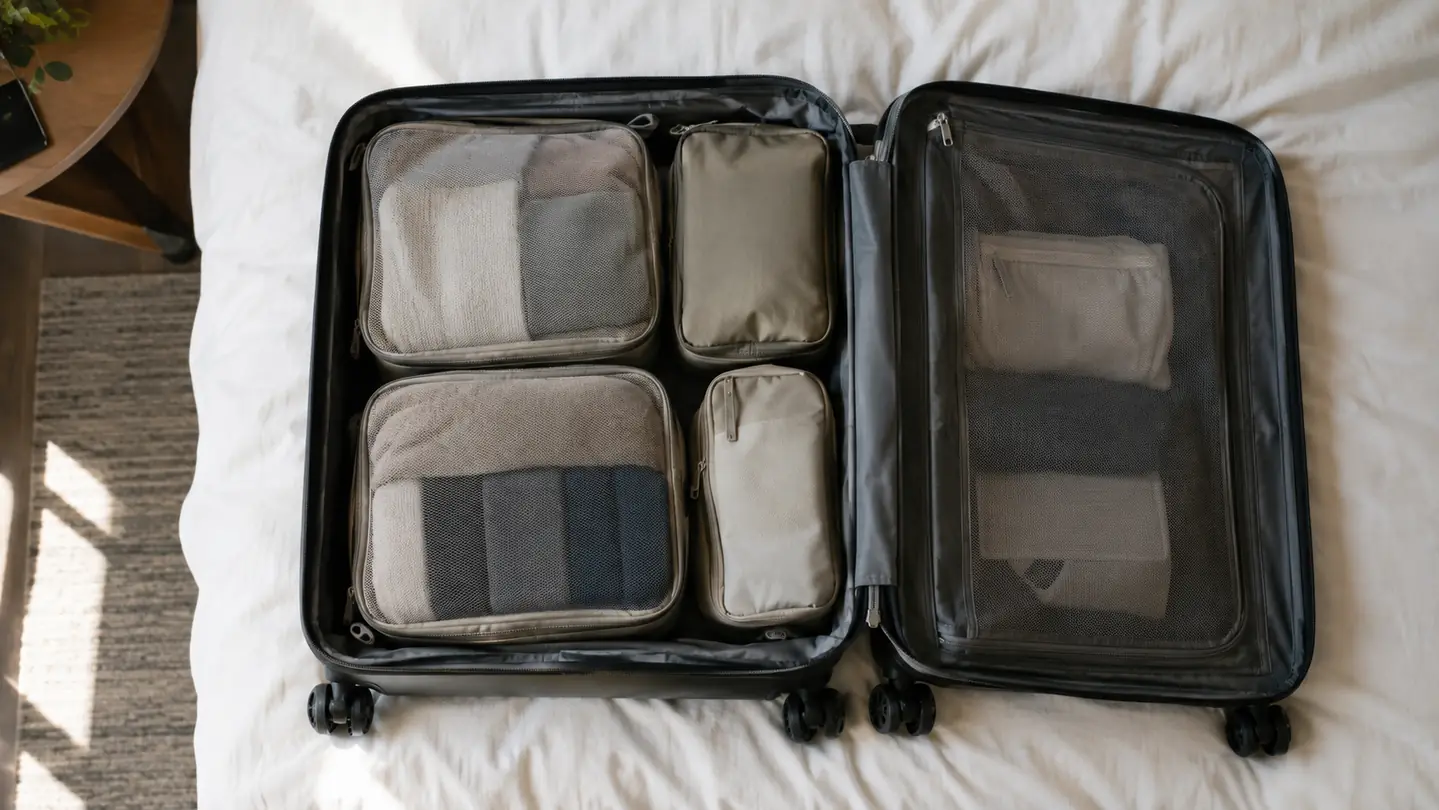
The BAGAIL set comes with eight cubes: two large, two medium, two small, and two slim. That sounds like a lot, but you will not use all eight for a week. I use two large, two medium, and one small. The large cubes hold my pants and heavier layers, the medium cubes hold shirts and dresses, and the small cube holds underwear and socks. The remaining three stay home or hold chargers, toiletries, and the odds and ends that would otherwise roll around loose.
The key is to match the cube to the clothing category, not to try to fill every cube to the brim. A cube that is too full will not compress well and will bulge in the middle of your suitcase. A cube that is half empty wastes space. You want each cube packed full but not stretched, like a loaf of bread that fills the pan without overflowing.
A quick note on matching cube sizes to your suitcase: lay your empty cubes in the open carry-on before you pack anything. You want two large cubes side by side to fill the main compartment, with medium and small ones filling the gaps. If the large cubes overhang the edges, your set is too big for your bag, and no amount of rolling will fix that.
Step 2: Roll everything, then sort by category
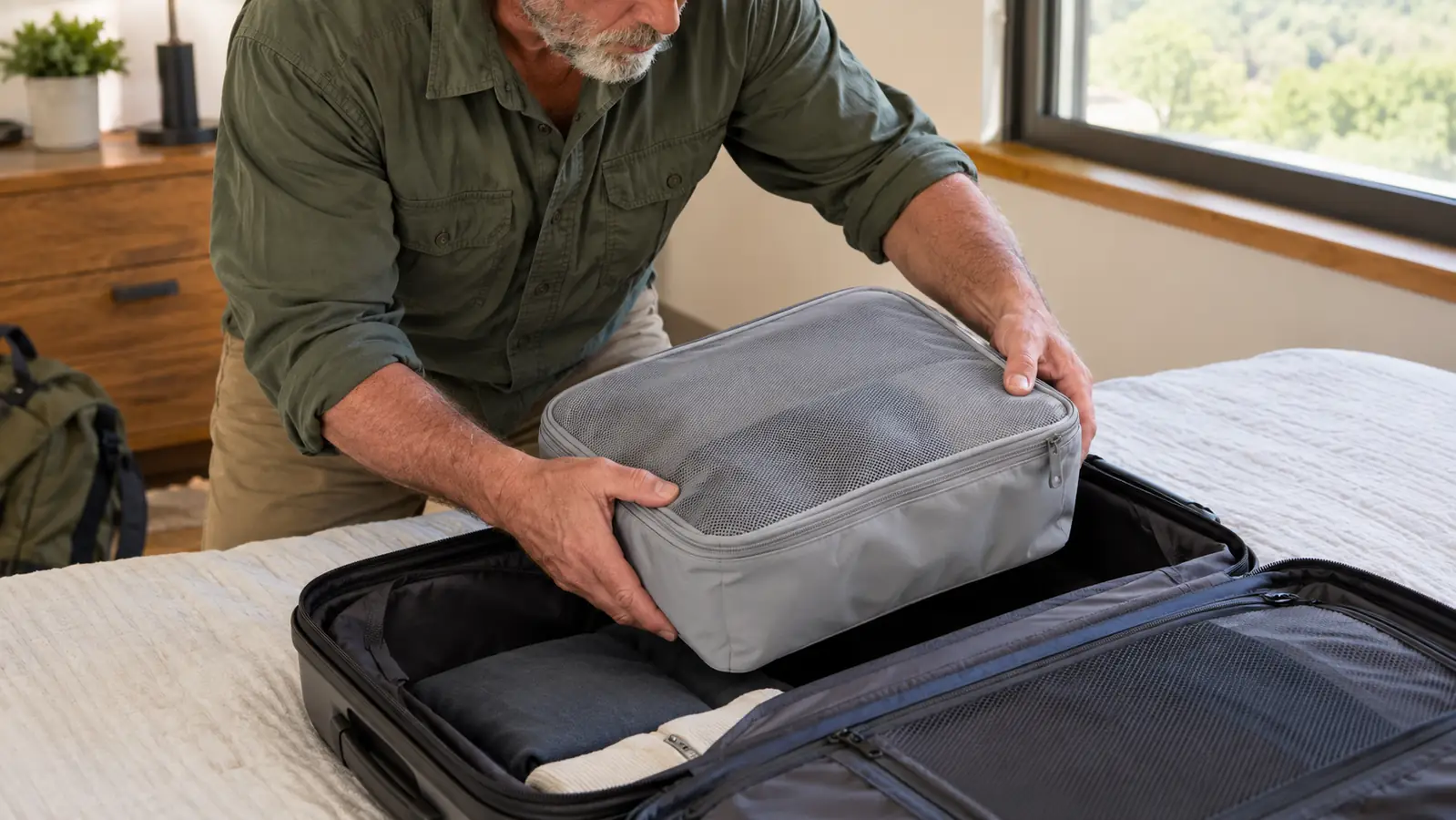
I know the internet loves a good debate about rolling versus folding. Here is my answer after years of testing both: roll your clothes, then put the rolls into cubes. Rolling saves space, keeps wrinkles down, and makes it easy to see what you have without unpacking everything. Fold only the things that wrinkle easily, like dress shirts or linen pants, and lay those flat on top of the rolled items inside the cube.
Sort by category before you pack. All the pants go in one large cube, all the shirts in another, all the underwear and socks in a small cube, and anything bulky like a sweater or a light jacket in the second large cube. This does two things. It makes packing faster because you are not hunting for a matching pair of socks, and it makes unpacking at the hotel faster because you pull out one cube and you are done.
A trick I learned the hard way: roll socks and underwear together, one pair of socks rolled inside a pair of underwear, so you never lose a single sock to the bottom of the bag. It sounds silly, but it saves real time in a hotel room at 11 at night.
Step 3: Pack the cubes in the right order
The order of cubes inside the suitcase matters more than you would think. Put the heaviest, bulkiest cube at the bottom, against the wheels. For me, that is the large cube with pants and jeans. Then stack the medium cubes on top, with the small cube in any leftover gap. This keeps the weight low, which makes the suitcase easier to roll, and it keeps the bag balanced so it does not tip over in the overhead bin.
If your suitcase has a compression strap inside, use it. The BAGAIL cubes are soft-sided, so the strap flattens them down and keeps everything from shifting during the flight. If your suitcase does not have a strap, tuck a folded jacket or a pair of shoes along the side to fill the gaps and hold the cubes in place.
One more thing I learned from a very bumpy flight to Chicago: put anything fragile, like a camera or a bottle of medication, in the small cube and place it on top, not at the bottom. You do not want your weight on your camera for three hours.
The order matters because of how you will unpack. The cube you need on day one, usually pajamas and the next day's outfit, goes on top. Cords, chargers and a spare pair of socks go in a small cube near the handle side, where you can reach them without opening the whole bag. The bottoms cube goes on the bottom because jeans and trousers are heavy and give the suitcase a stable base when you roll it.
If the lid will not close, do not sit on it. Open the cubes and take one item out of each. Overstuffed cubes put pressure on both the cube zippers and the suitcase zipper, and that is how zippers fail halfway through a trip.
Step 4: Use the lid and the gaps for shoes and toiletries
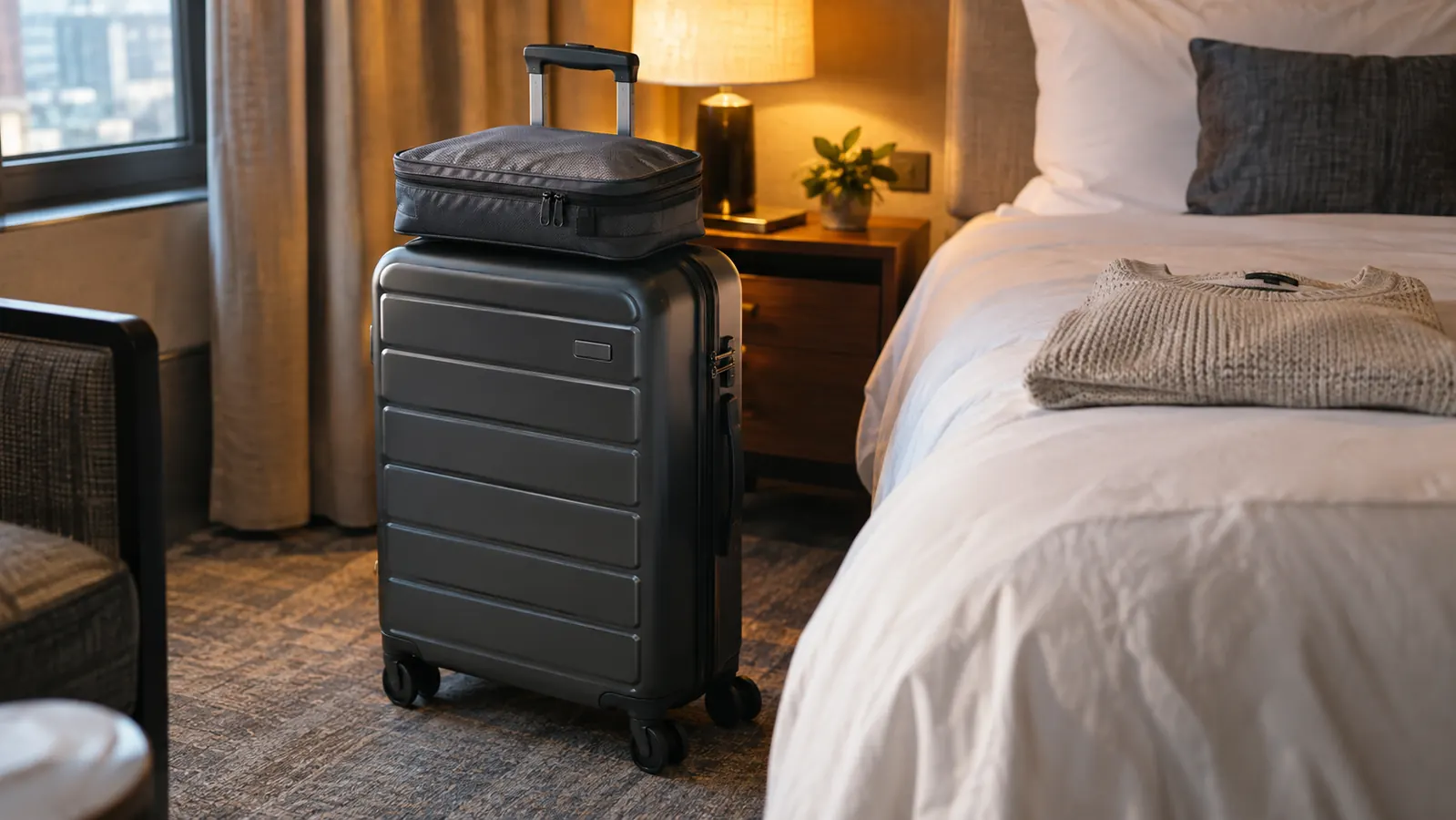
Shoes are the enemy of the carry-on. My rule is three pairs maximum: one pair of comfortable walking shoes, one pair of sandals or nicer shoes for dinner, and the shoes on my feet. That is it. If I need more than three pairs for a trip, I am packing for a person I do not want to be.
Put the shoes in the lid of the suitcase, soles down, with the toes pointing toward the hinges. If you have shoe bags, use them. If you do not, a shower cap or a plastic grocery bag works fine. I have also used the BAGAIL slim cubes for shoes, and they work well because the cube keeps the soles from touching your clothes.
Toiletries go in the gaps around the cubes, not in a cube of their own. I use a small hanging toiletry bag that fits in the space next to the medium cubes. Liquids go in a quart-sized bag on top, where I can reach them for security. This is the part of packing that most people overthink. You do not need a special system. You need a bag that fits the space you have.
Shoes are the item that ruins most carry-on plans, so I limit myself to two pairs: one on my feet and one in the bag. I stuff socks inside the packed pair to save space and slide them into a shower cap or a thin bag so the soles do not touch my clothes. Toiletries go in a clear quart bag near the top, because I will need to pull it out at security.
Step 5: Wear your heaviest items and keep a packing list
The single biggest space saver is not a cube at all. It is wearing your heaviest items on the plane. I wear my walking shoes, my jeans, and a light jacket. Mark thinks I am being dramatic, and then he watches me breeze through security while he is carrying a coat over his arm and holding his shoes in his hand. Wear the bulky stuff. Your suitcase will thank you.
Keep a packing list on your phone, and update it after every trip. Mine is just a note with the categories: pants, shirts, underwear, socks, shoes, toiletries, chargers, medications. When I get home, I add anything I wished I had brought and delete anything I did not use. Over time, the list gets shorter and the suitcase gets lighter. It is the closest thing to a superpower I have found in retirement.
The last step is the one everyone skips: weigh your suitcase before you leave. I bought an inexpensive small luggage scale, and it has saved me from overweight fees more times than I can count. A week of clothes in BAGAIL cubes usually comes in well under the limit, but the scale catches the times I added one too many books.
Finally, write your packing list once and keep it. I keep mine on my phone and tweak it after each trip, crossing off anything I did not use. After a few trips you will notice you pack less every time, and the cubes make that easy to see, because the cube you never opened is the one you did not need.
What Else Helps
A few small things make the carry-on life easier. A lightweight backpack or tote that fits under the seat in front of you holds your laptop, your book, and your snacks. A reusable water bottle, empty through security and filled at the gate, saves you four dollars and a lot of thirst. And a small laundry bag, or even a plastic grocery bag, keeps dirty clothes separate from clean ones on the way home. None of these cost much, and all of them make the system work better.
If you travel with a partner, divide the space. Mark and I each get one carry-on and one personal item, and we do not pack for each other. He packs too little, I pack too much, and somehow it evens out. The cubes make it easy to see what you actually have, which is the whole point.
The first time I packed a full week into a carry-on with BAGAIL cubes, I stood back and stared at the suitcase like it had performed a magic trick. It had not. It had just done what good organization does: made the hard thing feel easy.
Pack once, pack right, and skip the baggage claim
The BAGAIL 8 Set Packing Cubes have held up through a year of trips out of Denver, and they cost less than a checked bag fee on most airlines. If you are ready to stop wrestling your suitcase, this is the easiest place to start.
Amazon Check Today's Price on Amazon →