
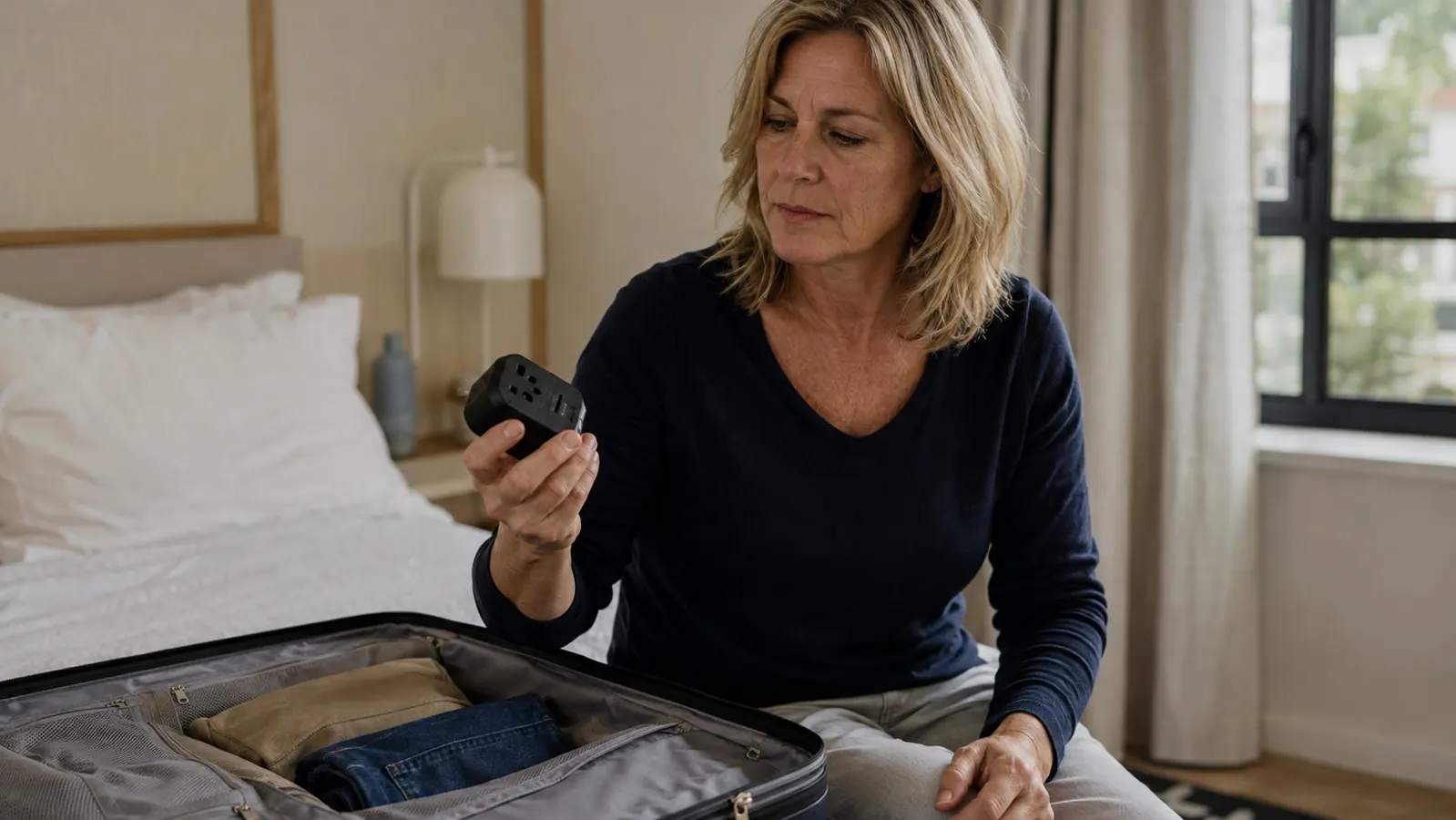
For years I packed the way I taught geography: prepared for every possibility. My carry-on had a zippered pouch with a UK plug, a European two-pin plug, an Australian plug, and a few adapters I could not even name anymore. It weighed almost nothing, but it took up mental space. Every hotel room meant a little archaeology project: which one fits this outlet, and do I need the one with the round pins or the flat ones? Then I spent a night in Lisbon with nothing but an EPICKA Universal Travel Adapter and a phone at 4 percent, and I stopped being sentimental about the pouch. That night was my own fault, which is probably why I remember it so well. We flew Denver to Lisbon through Newark on a small regional jet, and the flight attendants gate-checked every roller bag because the overhead bins were full. My pouch of single-country plugs was in that roller. The EPICKA adapter was in my tote, because I had bought it the week before and wanted to try it on a real trip. At 11:45 that night, in a hotel room in the Alfama with the window open and the trams quiet, I had one wall outlet, three devices, and a phone that would not last until breakfast. I slid the pins to the European position, plugged in the EPICKA, and everything came up full by morning. That was the end of the pouch for me.
This is the short answer: if you fly five or six times a year like I do, and you visit more than one country per trip, an all-in-one adapter like the EPICKA Universal Travel Adapter with 1AC/3 USB-C/2 USB-A Ports is the better buy. If you take one trip a year to the same country, a single-country plug is lighter and cheaper. I tested both approaches on real trips over the last year, and here is the honest breakdown.
| EPICKA Universal Travel Adapter | Single-Country Plugs | |
|---|---|---|
| Price | One adapter covers 150+ countries, one-time cost | Cheaper per plug, but you buy several and replace lost ones |
| Ports | 1 AC outlet plus 3 USB-C and 2 USB-A ports, charges phone, camera, and e-reader at once | One plug, one device at a time unless you also carry a separate charger |
| Packing weight | About the weight of a deck of cards, one item in the bag | Lighter individually, but the pouch of five or six adds up and gets lost |
| Coverage | Works in the US, UK, Europe, Australia, and most of Asia with sliding pins | Only works in the one country you bought it for |
| Ease of use | Slide the pins, plug in, done. No thinking required at 11 PM after a long flight | You have to find the right plug first, and it is usually at the bottom of the pouch |
| Best for | Multi-country trips, carry-on only, travelers who charge several devices | One destination, one week, minimal gear |
Where EPICKA Wins
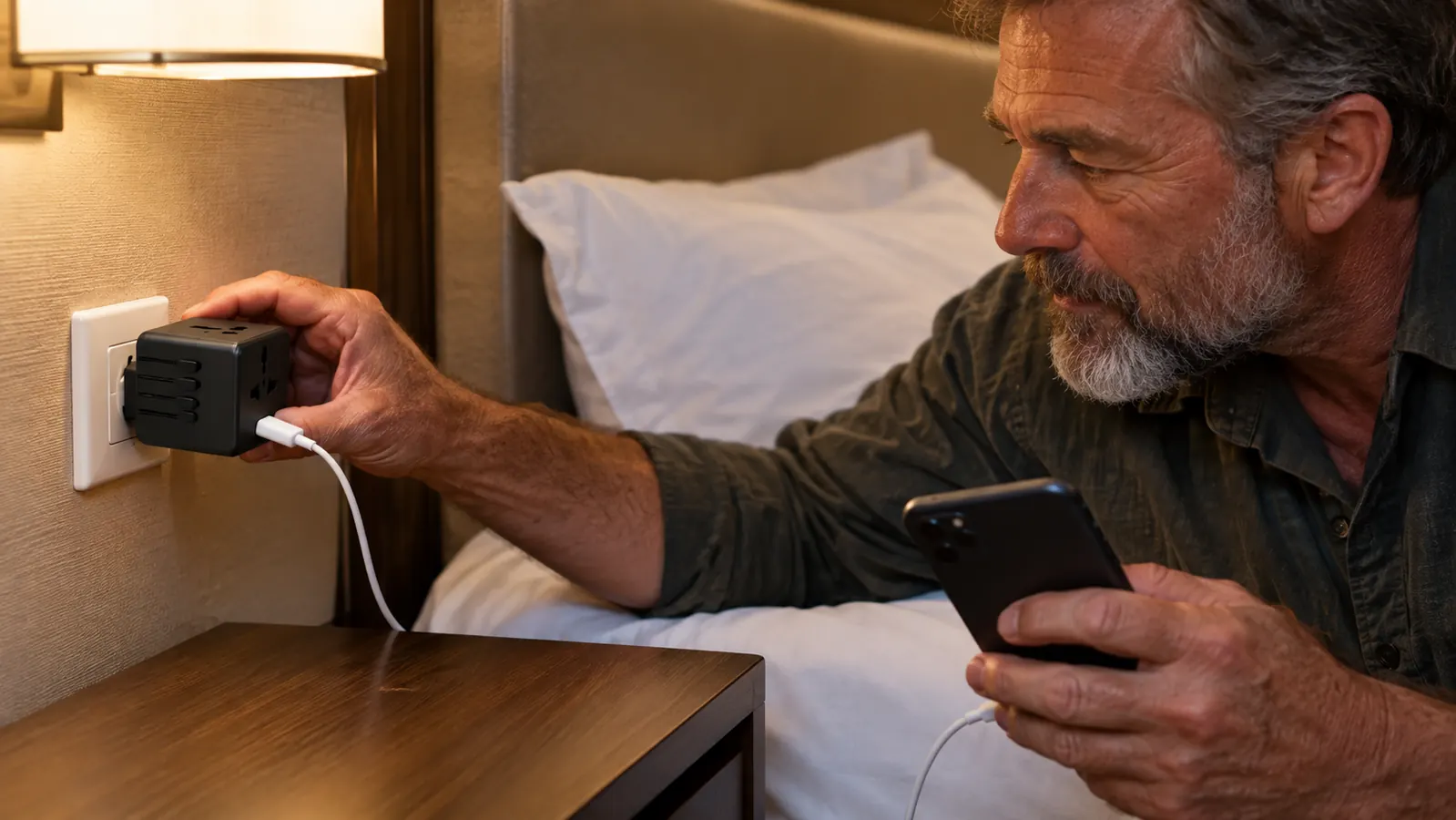
The EPICKA adapter wins on the days that actually matter: the ones where you are tired, the light is bad, and you just want your phone to charge. In Lisbon, I slid the pins to the European setting, plugged it into the wall, and charged my phone, my camera, and my e-reader from the same little block. My old system would have required the European plug for the phone, then a different plug for the camera, then a hunt for the third adapter that had rolled under the bed. The EPICKA adapter did all of it at once, and it did it without me having to think. That first night I put the phone on one USB-C port, the e-reader on the other, and the camera battery charger on a USB-A port, then hung the whole little block from the outlet by the bed and went to sleep. At 6:40 the next morning everything was full, including the phone that had been hovering at 4 percent. I did not have to decide which device got to live. With the pouch I would have had one adapter, one outlet, and a quiet argument about priorities, and I have had that argument often enough to know it is never worth it.
It also wins on the USB-C front. My phone, my e-reader, and my husband Mark's tablet all charge over USB-C now. The EPICKA adapter has three USB-C ports and two USB-A ports, which meant we could charge both of our phones, Mark's tablet, and my camera battery charger from one wall outlet. In a hotel room with one outlet by the bed and another behind the dresser, that is not a convenience. That is the difference between waking up to full batteries and waking up to a hunt for the one outlet that works.
The sliding pins took me a minute to trust. On my first trip with the EPICKA adapter, I stood in a Dublin hotel room, alone because Mark was downstairs checking the pub the front desk had recommended, and pushed the pin slider back and forth a few times before I believed it would stay put. Mark is a retired electrician, and I had a private little fear that he would come upstairs, look at the sliding mechanism, and tell me it was a gimmick that would strip out within a year. It did not happen. The pins lock into place with a firm click, and after eleven trips I have never had them slip or feel loose in a wall outlet, including a train station in Milan where the socket wobbled with every other adapter I owned. That matters to me because I am the person who used to carry a tiny screwdriver to pry a stuck adapter out of a socket. I have not needed it once since I switched.
The port layout is the part I did not expect to love. The EPICKA adapter has one AC outlet on the side, which means I can still plug in a laptop charger or a small travel iron while two phones and a camera battery charge from the USB ports. On a trip to Japan last spring, Mark and I shared one wall outlet in a tiny Kyoto room: his tablet on the AC side, my phone and his phone on USB-C, and my camera battery on USB-A. Everything was full by morning, and we did not have to take turns. That matters more than it sounds, because the room really did have exactly one outlet. It was a small ryokan near Gion with tatami floors and a low table, and the only wall outlet was behind the dresser by the window, a good six feet from the futon. We arrived at 9:20 at night after the Shinkansen from Tokyo, too tired to negotiate a charging schedule. I plugged in the EPICKA, and both phones, the tablet, and the camera battery all went into the wall at once. Mark read for twenty minutes, set his phone down at 62 percent, and never mentioned charging again for the rest of the trip. With two single adapters, one of us would have been sitting on the floor by the dresser waiting for a turn.
Where Single-Country Plugs Win
I am not going to pretend single-country plugs have no place. They do. If you are flying to London for a long weekend and you know you will only need a UK plug, a single adapter is lighter, smaller, and cheaper than the EPICKA. It also has no moving parts, so there is nothing to slide, no pins to adjust, and nothing to figure out. You plug it in and you are done. For a traveler who visits the same country every year and never brings more than a phone and a charger, the single plug is the honest choice.
Single plugs also win on the psychological front, which I did not expect. There is no decision to make. You do not stand in a hotel room at midnight wondering whether you slid the pins to the right position. You just know. My husband Mark, who packs too little and thinks about adapters for approximately zero seconds, prefers a single plug for exactly that reason. On our London trip in October he packed one UK plug from the hardware store, used it every night, and never looked at it twice. For him, the EPICKA adapter is one more thing to look at. For me, it is one less thing to think about. Both of us are right, depending on the trip.
There is also the matter of the outlet itself. Some older buildings in Europe have recessed sockets, and a bulky all-in-one adapter can sit too far from the wall to fit. I ran into that once in a converted monastery in Sintra, where the socket sat a good half inch back in the plaster and the EPICKA adapter was just too thick to seat properly. I switched to the small two-pin plug from my old pouch and it worked, which is the honest note this comparison needs: the universal adapter handles most of my nights, and the single plug handles the odd old wall that refuses to cooperate. It is worth knowing about if you stay in old buildings, and it is the main reason I have not thrown the pouch away.
Single plugs are also easier to replace. If I lose the EPICKA adapter, I have to order another one and wait for it to arrive. If I lose a single-country plug, I can usually find a basic version at a pharmacy or a train station kiosk for pocket change. That is a real advantage for someone who is absent-minded, and I say that as someone who once left a whole pouch of adapters in a hotel drawer in Rome and did not realize it until I was on the train to Florence.
One adapter for every country you will visit this year
The EPICKA Universal Travel Adapter covers 150+ countries, charges up to five devices at once, and takes up less space than a passport. I have used mine on ten more trips since Lisbon and it has never let me down.
Amazon Check Today's Price on Amazon →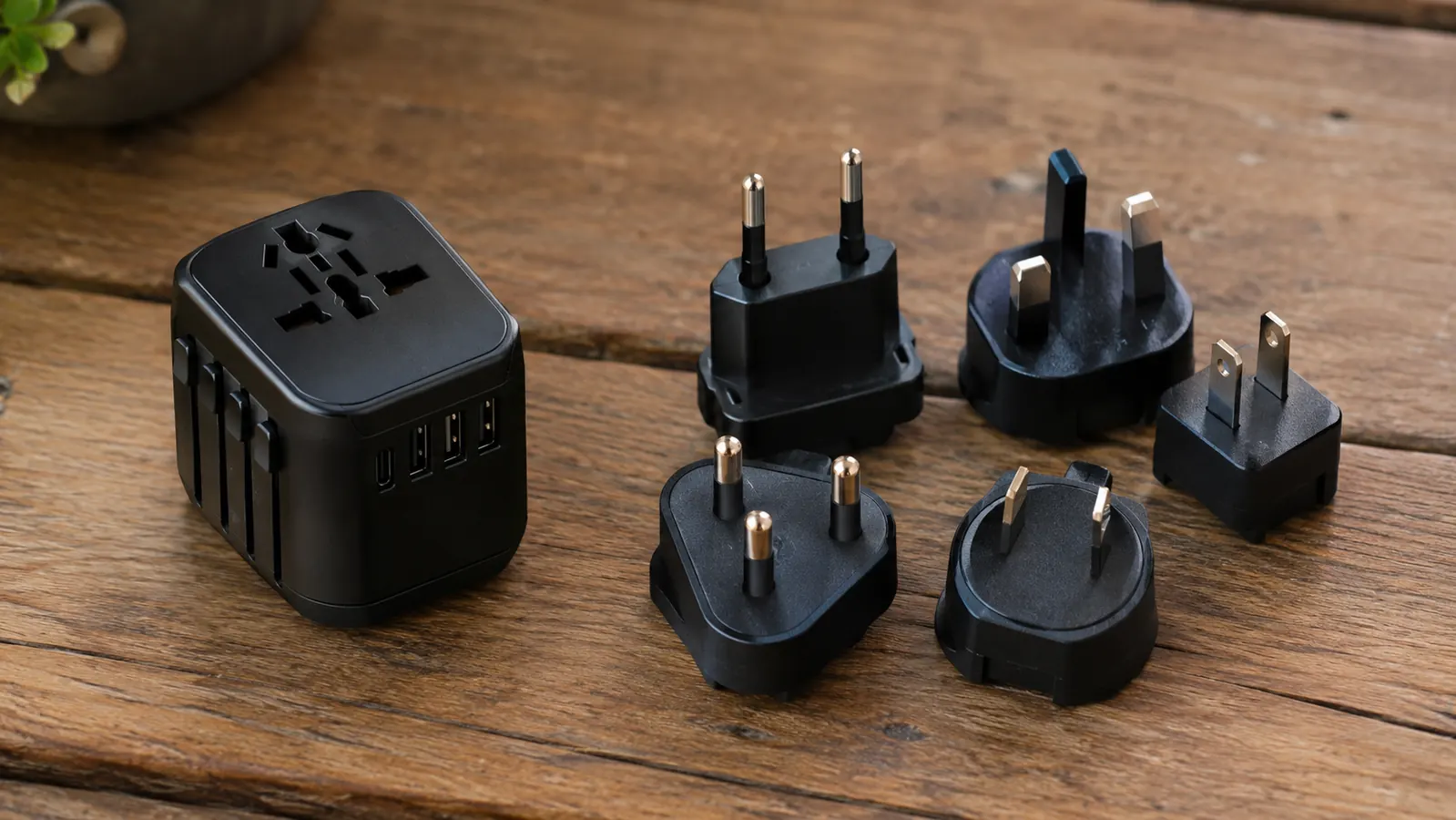
Who Should Buy Which
Buy the EPICKA Universal Travel Adapter if you travel like I do: several trips a year, often to more than one country, usually with a phone, a camera, an e-reader, and sometimes Mark's tablet. It replaces the whole pouch of plugs, charges everything at once, and it has survived eleven trips in my carry-on without a scratch. It is also the better choice if you are a gift-giver. I have bought two of them as gifts for friends who travel, and both friends came back with the same comment: why did I not get one of these years ago.
Buy a single-country plug if you take one trip a year, always to the same place, and you only need to charge a phone. There is no shame in that. Packing light is a skill, and the person who knows exactly what they need is packing lighter than the person who brings everything. But if you are the person who brings everything, the EPICKA adapter is the everything that actually earns its space.
One more thing I have learned the hard way: whatever you choose, test it before you leave. Plug the EPICKA adapter into a wall outlet at home, slide the pins through every position, and charge something overnight. I did that before my first trip with it, and it meant the difference between a confident slide in Lisbon and a fumbling guess at midnight. The same goes for a single plug. Know which end goes in the wall before you are standing in a dark hotel room trying to remember. My friend Dana, who teaches art history and travels far less than I do, learned this the expensive way on her first solo trip to Edinburgh in March. She had borrowed a single-country UK adapter from a colleague, which was kind, but she had never held a UK plug before, and she stood in her hotel room for fifteen minutes convinced she was doing it wrong because the plug sat at an angle in the outlet. It was not wrong. UK sockets are just like that, and there is a small switch on the socket that needs to be on. She sent me a photo at 9:37 at night and I told her it was fine, that is how they fit, and to flip the switch. Travel adapters are not hard, but they are unfamiliar, and unfamiliar things feel hard at the end of a long travel day. Ten minutes at your kitchen counter before you fly saves you that phone call.
Pack one adapter instead of a pouch of plugs
The EPICKA Universal Travel Adapter has handled every country I have thrown at it, from Portugal to Japan. It charges five devices at once and fits in the smallest pocket of my carry-on.
Amazon Check Today's Price on Amazon →