

I am Corinne, the retired geography teacher from Denver who finally gets to see the places I spent 28 years pointing at on a map. Mark and I fly five or six times a year, and somewhere between Lisbon and Tokyo I got tired of the little zippered pouch of single-country plug adapters that never had the one I needed. The pouch was my own doing. I had bought a separate adapter for nearly every trip the way you buy a new umbrella because the old one disappeared, and I ended up with a UK one with three rectangular prongs, a European one with two round pins, a Japanese one with two flat pins, and one for Thailand that I was sure matched the European one until I stood in a Bangkok hotel room at 11 p.m. with a dead phone and found the pins sat at a slightly different angle. When I needed a charger, I would hold the pouch up to the bedside lamp and squint at each adapter like a woman reading a menu in a language she only half knows. So before a three-week trip through Europe, I ordered the EPICKA Universal Travel Adapter with 1AC/3 USB-C/2 USB-A Ports. Eight countries and eleven trips later, it is the first thing I pack, and the pouch lives in my desk drawer at home.
This is not a sponsored post and I bought it with my own money. It is a long-term review from someone who has charged a dead phone in a Lisbon hostel, kept a laptop alive through a work trip in London, and learned exactly which ports earn their space in a carry-on. I am not a gadget reviewer and I did not bring a multimeter or a wattmeter abroad. I am a 54-year-old former teacher with a bad left knee who spends a lot of time in airport security lines and hotel rooms, and I am telling you what this adapter did on real trips, including the two moments when it nearly let me down. Those two moments are part of this review too, because a traveler should hear the bad along with the good.
The Quick Verdict
The EPICKA Universal Travel Adapter is the rare travel gadget that earns its spot in every bag. It handled outlets in eight countries, charged five devices at once, and survived being dropped on a marble floor in Rome. It is not the smallest adapter you can buy, and the lack of a built-in voltage converter means you still need to check your hair dryer. For most travelers, that trade is worth it.
Amazon Check Today's Price →Stop juggling a pouch of single-country adapters
One EPICKA Universal Travel Adapter covers the outlets I actually met across eight countries, with six ports for every device in my bag. Check today's price on Amazon and see if it fits your packing list.
Amazon Check Today's Price on Amazon →How I've Used It
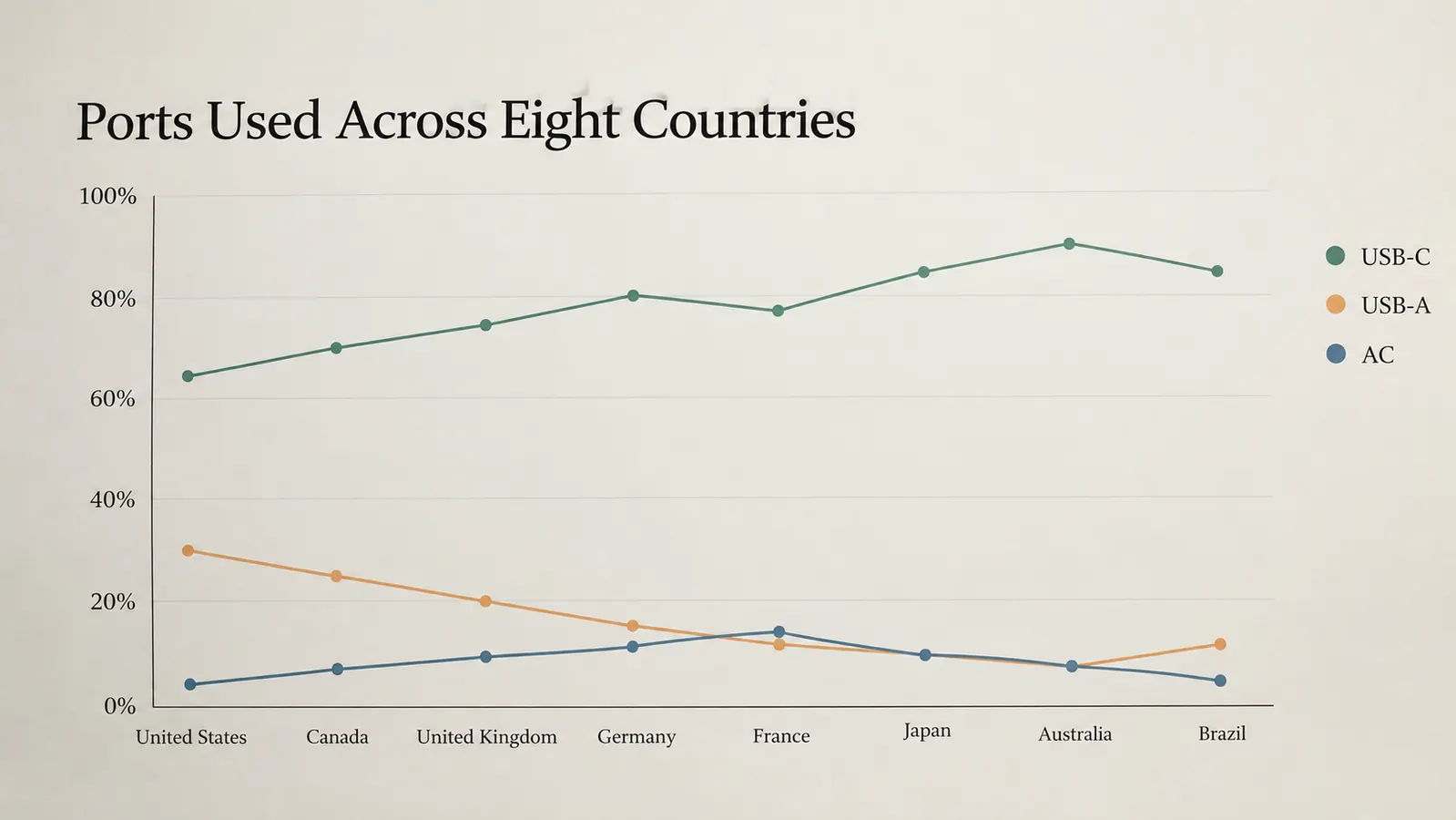
I have used the EPICKA adapter on eleven trips since I bought it in March of last year, in eight countries: Portugal, Spain, France, Italy, the United Kingdom, Japan, Thailand, and Mexico. The first trip was a three-week run through Lisbon, Madrid, Paris, and Rome. The second was a long weekend in London for a friend's retirement party. Then came a two-week trip to Japan that I had promised myself for a decade, a shorter one to Thailand in January, and a week in Mexico City in the spring. That mix matters because it covers the four main plug types a traveler actually meets: the two-round-pin outlets of most of Europe, the three-prong British outlets with their angled pins, the two-flat-pin outlets of Japan and North America, and the two-round-pin outlets with different spacing that Thailand sometimes throws at you.
My typical charging setup at the end of a travel day looks like this: my phone on USB-C, Mark's phone on the other USB-C port, my e-reader on USB-A, his camera battery charger on the second USB-A port, and my laptop on the AC outlet. That is five things at once, and the adapter has never complained. The sixth port, the extra USB-C, usually ends up charging a portable battery or a pair of earbuds. One night in a Lisbon hostel the room had exactly one socket, mounted high on the wall near the ceiling, and I balanced the adapter on top of my toiletry bag so everything could reach the cords. Mark thought I was overcomplicating it until his camera battery hit full at 9 p.m. and the slow USB-A port he had grumbled about turned out to be the one that saved the evening.
The sliding mechanism that switches between plug types is the part I was most worried about. Plastic sliders on cheap adapters feel like they will snap the first time you push them, and I have broken two that way over the years, one in a hotel in Florence and one in my own kitchen. This one clicks firmly into each position and has stayed tight through dozens of switches. In Tokyo, I slid it from the European position to the Japanese position on a train platform at 4 a.m. with a departure board counting down, and it locked in on the first push. I still check the little lock before I plug it in, especially in Japan, where the outlet sits so low that I have to bend my bad knee to reach it, but after eight countries I trust it.
What the Six Ports Actually Mean on the Road
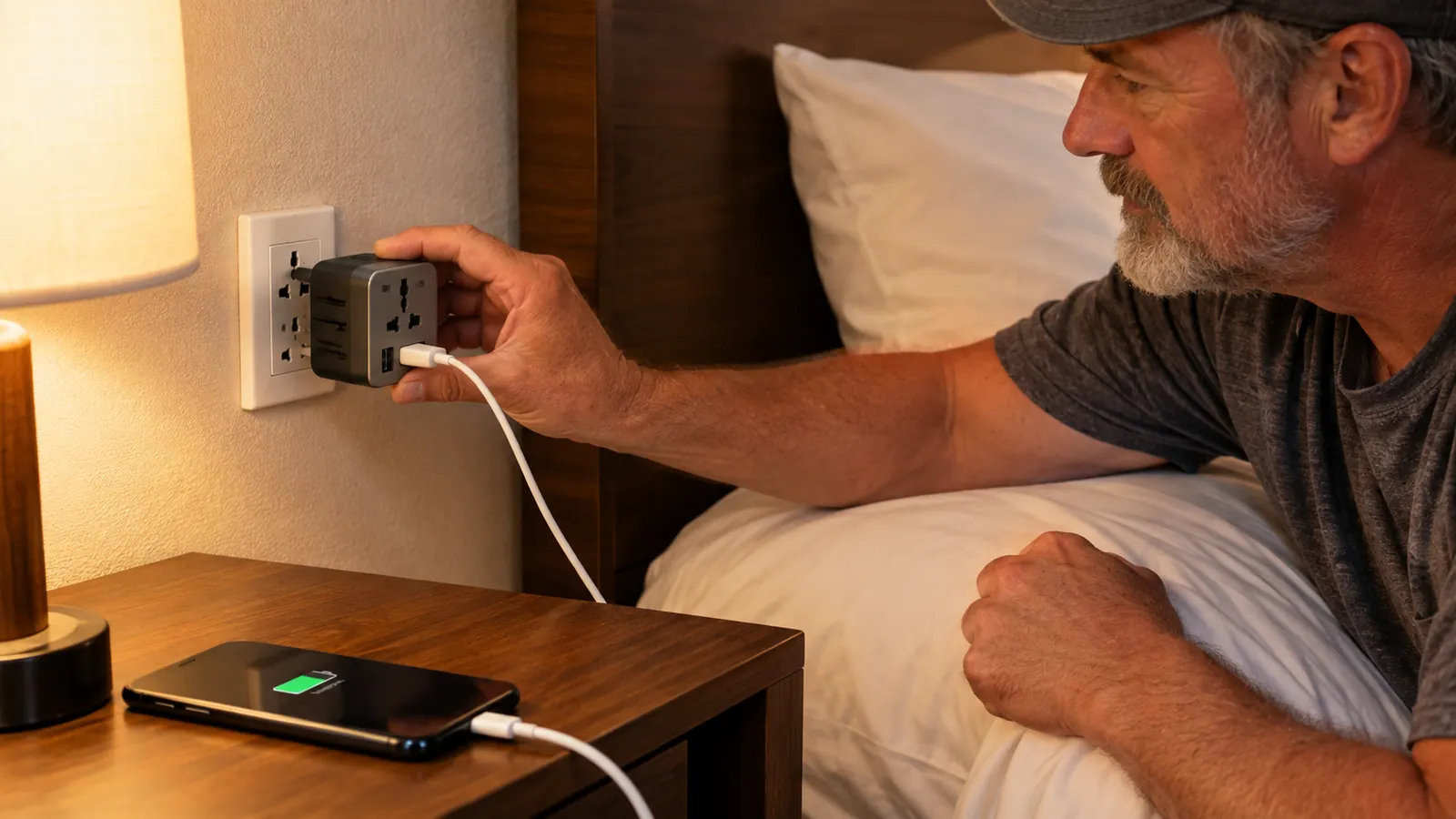
The EPICKA Universal Travel Adapter gives you one AC outlet, three USB-C ports, and two USB-A ports. On paper that sounds like overkill. In practice, it is the difference between playing musical chairs with chargers and plugging everything in at once. Before I owned it, I packed two small single adapters and one double-USB charger, and I still ended each evening deciding which device would sleep hungry. Now I plug everything in before I take off my shoes, and by the time I have brushed my teeth, the row of little lights on the chargers tells me the whole story.
The AC outlet is the one that saves you in hotels. Many hotel rooms in Europe and Asia have exactly one accessible wall socket, and it is usually behind the nightstand, next to the lamp that is hard-wired in. In a small hotel room in Rome, the only free socket was behind the bed frame, and I had to reach around the post to use it. With the EPICKA adapter, that single socket became a charging station for the whole room: the laptop on AC, both phones and Mark's camera on USB, and my e-reader on the last port. I have plugged my laptop into the AC outlet while my phone, Mark's phone, and his camera gear all charged from the USB ports at the same time, and the adapter stayed cool enough to touch even after two hours of charging.
The USB-C ports are the workhorses. Two of them put out enough power to charge a phone quickly, and I have timed it: my phone goes from 12 percent to full in about an hour and a half on a USB-C port, which is the same speed I get at home on its wall charger. The third USB-C port is labeled for higher-power devices, and I have charged my tablet and my laptop from it on nights when I needed the AC outlet for something else. The USB-A ports are slower, but they are perfect for older devices and for the small accessories that still use the old cable, like the charger for Mark's camera remote and my portable speaker.
One honest note: the adapter does not convert voltage. It only changes the shape of the plug. My phone, laptop, camera, and e-reader all have chargers that handle 100 to 240 volts, so they are fine anywhere. My travel hair dryer does not, so it stays home, and I have learned to pack a microfiber towel instead. If you travel with a high-wattage appliance like a curling iron or a straightener, check the label before you plug it in, and if it reads 110 to 120 volts, leave it home or bring a real voltage converter, which is a heavier, separate piece of gear. This is true of almost every travel adapter on the market, but it is worth saying plainly because the product photos never mention it.
How It Held Up Over Eight Countries
The best thing I can say about the EPICKA adapter is that I stopped thinking about it. By the third country, I was not checking the plug type before I pushed the slider. I was not worried about whether the pins would fit. I just plugged it in, and it worked. The moment I remember most is a train station in Kyoto at 6 a.m., where a young woman asked in careful English whether I had an adapter I could lend her for her phone. I slid mine to the Japanese position, handed it over, and she charged her phone while we waited for the platform to open. She handed it back with a small bow, and there was not a mark on it.
It survived the usual travel abuse. It was dropped on a marble floor in a Rome hotel bathroom, and the impact left a scuff on one corner but did not crack the case. It was shoved into the bottom of my carry-on under a stack of paperback books on the flight home from London. It spent a week in a beach bag in Thailand, and I am not exaggerating when I say sand worked its way into the slider mechanism; I rinsed it under the bathroom tap, let it dry overnight on the balcony, and it has worked fine since. The build quality is noticeably better than the cheap airport-newsstand adapters I used to buy, the kind that wobbled in the socket and felt warm after an hour of charging. This one sits tight in the outlet, stays cool, and the USB ports have not loosened after eleven trips.
The one thing I would change is the size. It is not the smallest adapter on the market; a single-country adapter takes up about a third of the space and slides into a shirt pocket. If you are the kind of traveler who weighs every gram of carry-on luggage, there are slimmer universal options that trade the extra ports for less bulk. I know, because I carried one of those slim ones for years and it broke the second time I used it in a tight outlet in Paris. For me, the six ports are worth the extra weight, and the little indicator light has helped me find the adapter in a dark hotel room more than once.
I promised I would tell you the two moments it nearly let me down, so here they are. The first was in a hotel in Madrid, where the wall plate had a recessed socket and the sliding pins came out at an angle that would not seat; I had to push them in and hold the adapter for a full ten seconds before it caught. It worked, but I learned that even a universal adapter meets a wall plate it does not love. The second was in Thailand, where I pushed the slider to the wrong position and spent a worried minute convinced I had jammed it. I had not. I was tired, and the mechanism had clicked into the European position instead of the one I wanted. Both times the adapter itself was fine, and both times I was the problem.
By the third country, I stopped checking the plug type before I pushed the slider. I just plugged it in, and it worked.
Who This Is For
This adapter is for the traveler who carries more than one device. If you travel with a phone, a laptop, a camera, and a portable battery, the EPICKA Universal Travel Adapter will simplify your life. It is also for the traveler who visits more than one country per trip. A single-country adapter works fine for a week in Paris, but the moment you cross a border, you are back to carrying a pouch of options. Because I taught geography for 28 years, I have a soft spot for border crossings, and this adapter has never once made me stop and dig for a different plug. That is the whole job, and it does it.
It is especially good for couples who share one outlet. Mark and I have spent years fighting over the single socket in hotel rooms. With this adapter, we both plug in at the same time and stop arguing about whose phone gets to charge first. That alone was worth the space it takes in the bag.
Who Should Skip It
The EPICKA adapter is not for everyone, and I mean that. Skip it if you only travel to one country, carry one device, and stay in modern chains with plenty of outlets. A tiny single-country adapter will do the job and take up a fraction of the space. Skip it if you need to run high-wattage appliances like hair dryers or curling irons, because this adapter does not convert voltage and never will; you need a separate converter for those. And skip it if you want the absolute smallest possible adapter, because the six ports require some extra bulk that a minimalist packer will notice right away.
What I Liked
- Six ports charge a whole hotel room from one wall socket
- Sliding plug mechanism covers the four main plug types
- Solid build that survived a drop on marble and sand in Thailand
- USB-C ports fast-charge phones and tablets
- Small enough for a pocket, light enough for a carry-on
Where It Falls Short
- Bulkier than a single-country adapter
- No voltage conversion, so high-wattage appliances still need a converter
- USB-A ports are slower than the USB-C ports
- The slider takes a firm push, which can feel stiff at first
The Bottom Line
The EPICKA Universal Travel Adapter is not the cheapest adapter on the market and it is not the smallest. What it is, is the one I reach for every single trip. Eight countries, eleven trips, two near-misses that were my fault, and it has never let me down in any way that mattered. If you are tired of the pouch of single-country adapters, this is the one to buy.
Pack one adapter instead of a pouch of them
The EPICKA Universal Travel Adapter has earned its spot in my carry-on for eight countries and counting. Check today's price on Amazon and see if it belongs in yours.
Amazon Check Today's Price on Amazon →