

I have a confession to make. After 28 years of teaching middle school geography, I have packed for exactly the wrong number of trips. I am Corinne, I live in Denver, and since retiring I fly five or six times a year, mostly carry-on only. So when I tell you the Taygeer carry-on travel backpack surprised me, I mean it surprised someone who has spent decades overpacking and then complaining about it.
This is the honest review I wish I had read before buying. Not the product page version, not the five-star summary. The part where I tell you what the Taygeer backpack does well, where it gets awkward, and whether it actually fits under a seat when the flight attendant is watching.
The Quick Verdict
A comfortable, well-organized carry-on backpack that holds more than it looks like it should, with a few quirks you should know about before you buy.
Amazon Check Today's Price →The carry-on backpack I keep reaching for
After six trips with the Taygeer, it is the bag I grab first. Check today's price on Amazon and see if it fits your packing style.
Amazon Check Today's Price on Amazon →How I've Used It
I bought the Taygeer travel backpack in early spring, right before a week-long trip to visit my sister in Portland. Since then it has been through Denver International on every one of those trips, including a long weekend to Chicago, a five-day trip to Santa Fe with my husband Mark, and a longer international flight where I checked a bag but still carried the Taygeer as my personal item.
My test is simple. Can I pack for five days without checking a bag, carry it through the airport without my left knee complaining, and get it under the seat without a wrestling match? The Taygeer passed the first two. The third one took some practice.
For context, I am 54, I have a bad left knee, and I refuse to be the person holding up the aisle while a flight attendant sighs. Mark, my husband, packs too little and watches me pack too much. That dynamic has not changed. What changed is that I finally found a bag that forgives my overpacking.
I have carried the Taygeer backpack as my personal item on six round trips now, from a weekend in Salt Lake City to two weeks in Portugal. Most of the time it rides on top of my rolling suitcase, held in place by the trolley sleeve, and comes off for boarding and stairs. On a couple of trips it was my only bag, packed with three days of clothes in two small packing cubes.
What Nobody Tells You About the Capacity
The product page says this is a 40-liter bag. I have learned that liter counts on backpacks are optimistic, like restaurant photos. So I tested it the way I pack: with real clothes, a toiletry kit, a tablet, a book, and the inevitable extra pair of shoes.
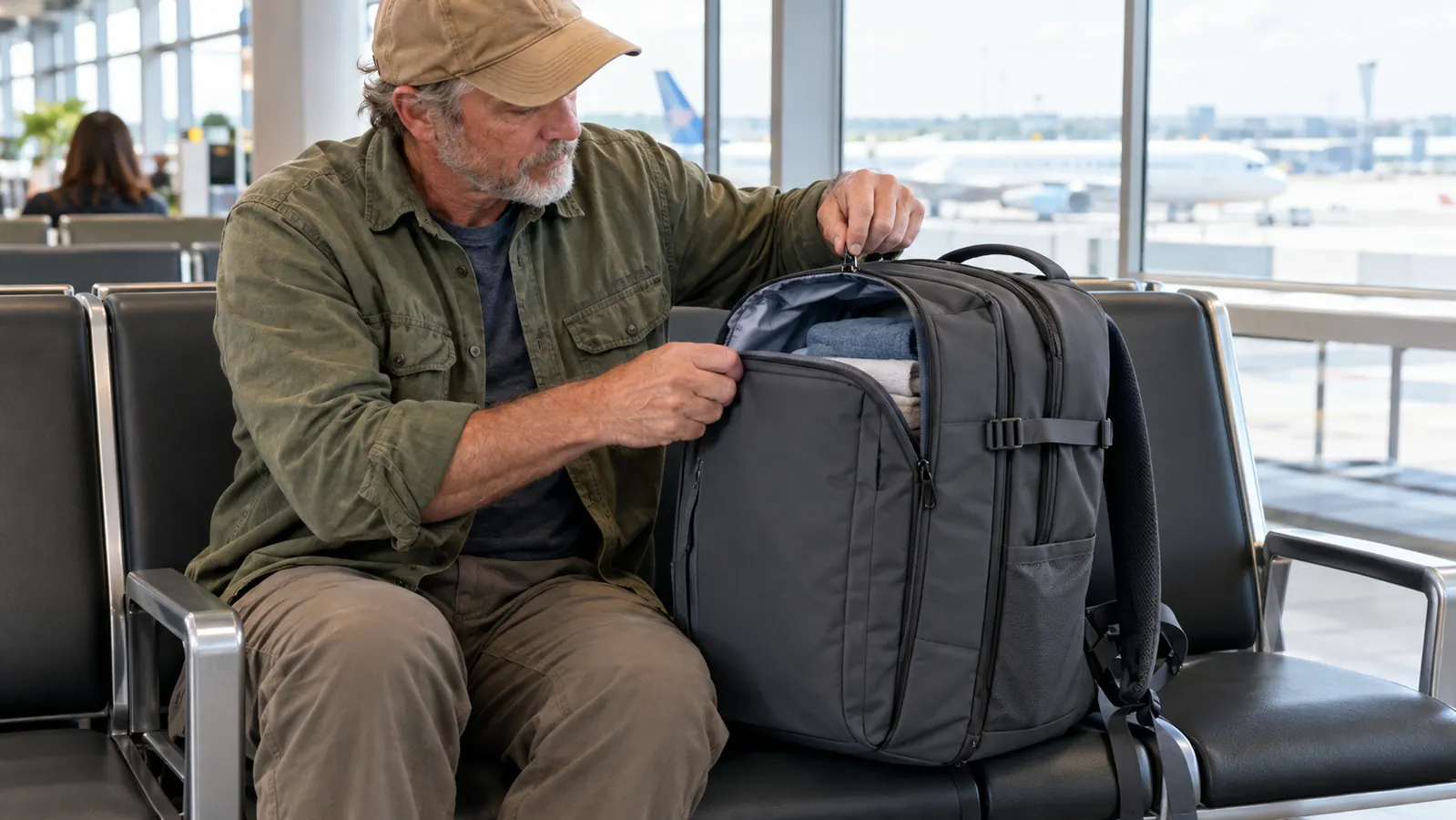
For a five-day trip, I fit four pairs of pants, five shirts, a light jacket, undergarments, socks, a toiletry bag, a tablet, and a pair of walking shoes. That is not a magic trick. It is the result of the bag opening like a suitcase instead of a top-loading stuff sack. The clamshell opening means you can actually use the full depth, and the compression straps on the inside pull everything down so the bag does not bulge.
What nobody tells you is that the capacity depends on the shoes. If you pack a second pair of bulky shoes, you will feel it. The bag handles soft items beautifully. Hard items, like a dopp kit full of bottles, eat space fast. I learned to put the hard items at the bottom near the wheels, which is not a feature listed anywhere, just a lesson from packing it six times.
The capacity is honest, but it depends on how you pack. Fully loaded with a laptop, a sweater, toiletries and a couple of days of clothes, the bag bulges and starts to push the limits of what fits under a seat. Packed sensibly, with soft things squeezed into the gaps, it holds a surprising amount and still slides under the seat in front of me.
The clamshell opening means you can actually use the full depth, and the compression straps pull everything down so the bag does not bulge.
Comfort, With One Caveat
The Taygeer has padded shoulder straps and a sternum strap, and the back panel is padded too. Walking through a long terminal with a fully packed bag, I noticed the difference. My shoulders did not ache the way they did with my old top-loading backpack, and the sternum strap kept the weight from pulling my neck.
Here is the caveat. The hip belt is minimal. It is more of a stabilizer than a weight-transfer belt. If you are carrying this bag for hours through a huge airport, the weight stays on your shoulders. For me, that is fine for the distance from the curb to the gate. If you are planning to hike with this bag or walk a mile through a city with it fully loaded, you will want a bag with a real hip belt.
The other comfort detail is the handle. The top handle and the side handle are both padded, which matters more than I expected. Lifting the bag into an overhead bin is easier when the handle does not dig into your hand. And with my knee, I appreciate that the bag has a luggage pass-through sleeve on the back, so I can slide it over the handle of a rolling suitcase when I do check a bag.
The caveat is the shoulder straps when the bag is heavy. They are padded and comfortable for the walk to the gate, but on a long day of walking with a full load I felt them by the afternoon. For a day trip with a lighter load they are perfectly fine. If you plan to carry it fully packed for hours, add a sternum strap or plan for breaks.
The Under-Seat Question
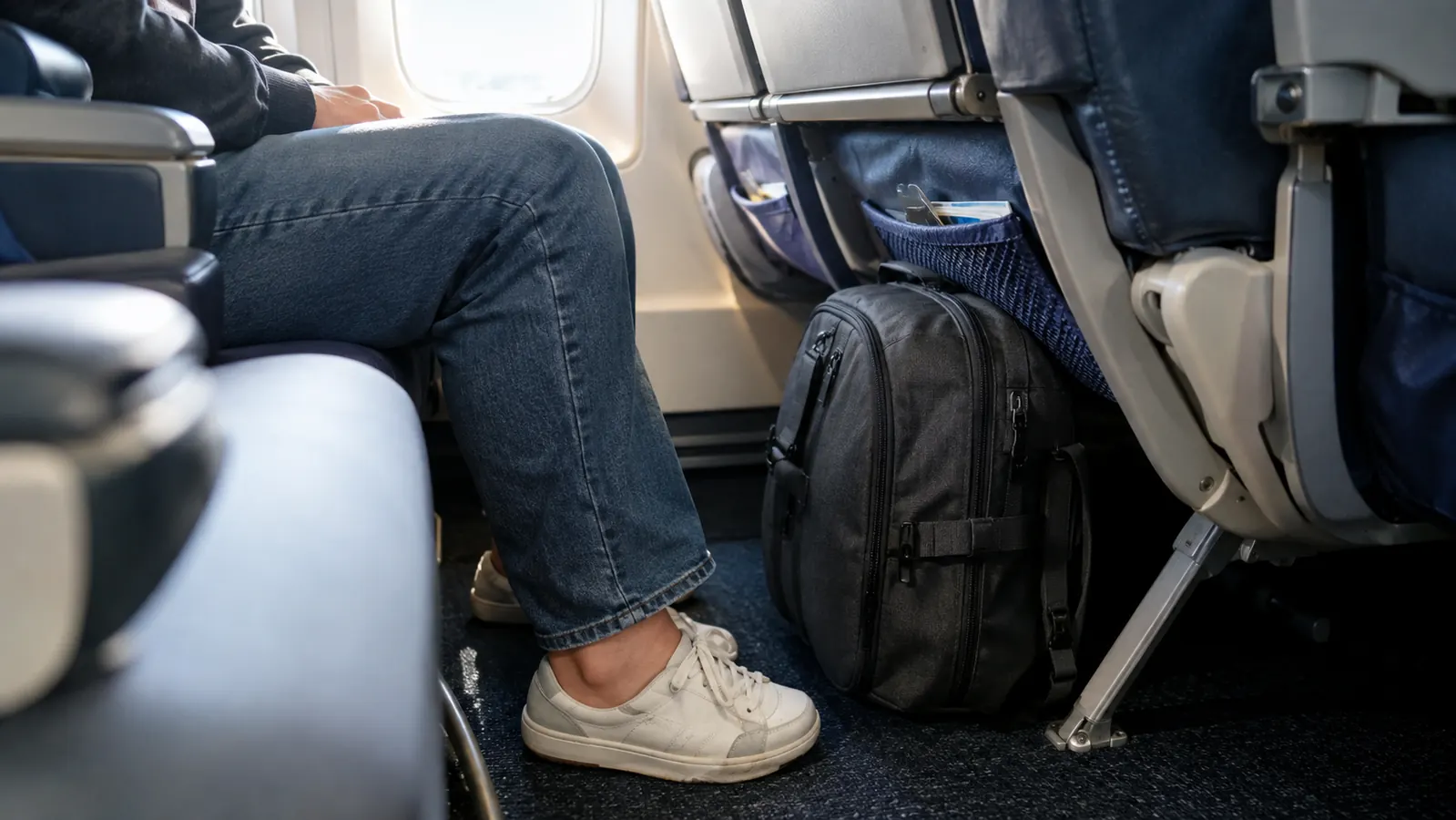
This is the question everyone asks, and the answer is: it depends on the airline. On a standard domestic flight, the Taygeer fit under the seat in front of me, but I had to take out the hard items and turn the bag sideways. It is not a bag you can shove under and forget. It is a bag you slide under, then nudge with your foot.
On a regional jet with smaller seats, it did not fit under the seat. I put it in the overhead bin instead, which worked fine because the bag is soft-sided and squished into the space without a fight. The flight attendant did not measure it, but I have heard stories, so I always keep the bag under-packed enough that it can compress.
If you are someone who wants to slide a bag under the seat and never think about it again, this is not that bag. If you are someone who packs like me, with a little too much and a lot of hope, the Taygeer gives you options. That flexibility is worth more to me than a bag that technically fits but holds nothing.
So far it has fit under every seat I have tried, including a couple of tight regional jets where I was nervous about it. The trick is not overstuffing the front pocket, which adds depth fast. When I keep that pocket light, the Taygeer slides in cleanly, and when I cram it, I have to push it in with my feet.
Organization: The Pockets You Will Actually Use
The Taygeer has a lot of pockets. I mean a lot. There is a laptop compartment that fits my 14-inch laptop, a tablet sleeve, a front pocket with organizers for pens and a passport, and two side pockets for a water bottle and an umbrella. I have used all of them, which is rare for me. Usually I ignore half the pockets on a bag and then forget where I put my boarding pass.
The pocket I use the most is the one on the back panel, the one that sits against your body when you wear the bag. It is perfect for a passport and a phone, and it is the pocket a pickpocket would have the hardest time reaching. I did not expect to love a hidden pocket that much, but I do.
The front pocket has a key clip, which sounds like a small thing until you are standing outside your hotel room at 10 PM digging for a key. The water bottle pockets are deep enough that a bottle does not fall out when you bend over, which is another small thing that makes a big difference.
The pockets I actually use are the laptop sleeve, the front organizer pocket for my passport, pen and reading glasses, and the side bottle pocket. The rest I mostly ignore, and that is fine. More pockets is not always better, and a few well-placed ones that you use every trip beat a dozen you forget about.
What Wears Well and What Does Not
After six trips, the zippers still move smoothly. The fabric has no visible wear, no loose threads, no scuffs that did not wipe off. The stitching around the handles has held up, which is where cheap bags usually fail first. I am not gentle with my bags. I toss them into overhead bins, drag them through security, and set them down on airport floors. The Taygeer has taken all of it.
What does not wear well is the water bottle pocket. The elastic has stretched a little, so a slim bottle now wobbles. It still holds a bottle, but I notice the difference. I also wish the shoulder straps had a little more padding at the top, where the weight settles. After a long day, I can feel the straps through my shirt.
The zipper pulls are metal and have not bent or broken. The main zipper has a small lock loop, which I have used once, on a train, and it worked. I will not pretend I use it every trip, but it is there if you want it.
What I Liked
- Opens like a suitcase, so you can actually see and reach everything
- Comfortable padded straps and back panel for airport walking
- Luggage pass-through sleeve works with a rolling suitcase
- Hidden back pocket is great for a passport and phone
- Fabric and zippers have held up through six trips
Where It Falls Short
- Hip belt is minimal and does not transfer much weight
- Under-seat fit depends on the airline and requires some nudging
- Water bottle pocket elastic stretches over time
- Hard items eat space fast, so packing order matters
Who This Is For
This bag is for the traveler who wants one bag that can do almost everything. It is for the person who flies carry-on only for a five-day trip and wants a bag that opens flat, has a laptop compartment, and does not make their shoulders ache. It is for the person who, like me, packs a little too much and needs a bag that forgives them.
It is also for the person who sometimes checks a bag. The luggage pass-through sleeve means the Taygeer becomes a personal item that rides on top of a rolling suitcase, which is how I used it on my international trip. That flexibility is the reason I reach for it instead of my old bag.
Who Should Skip It
If you are a minimalist who packs one small bag and wants it to disappear under a seat, this is more bag than you need. If you plan to carry it for hours through a city or on a hiking trail, the minimal hip belt will disappoint you. And if you want a bag you never have to think about, the under-seat fit will make you think about it on every flight.
I also would not recommend it for someone who wants a bag that stands upright on its own when fully packed. The Taygeer is soft-sided, so it slumps a little when it is not packed just right. That is a small thing, but it is the kind of small thing that annoys you in a hotel room.
To sum up the honest picture: the Taygeer backpack is a comfortable, well-organized personal item that fits under the seat if you pack it sensibly. It is not built for carrying a full load all day, and the front pocket can push it past the under-seat limit if you cram it. Used the way I use it, riding on my suitcase handle and coming off for boarding and stairs, it has been one of the best travel purchases I have made in years.
If you are buying it for longer trips as your only bag, practice packing it at home first. Lay out what you plan to bring, pack it with a couple of small cubes, and wear it around the house for twenty minutes. If it feels heavy in your living room, it will feel heavier at the airport.
One last detail I appreciate: the Taygeer cleans up easily. A damp cloth took off a coffee splash and a smear of airport grime without leaving a mark, and the bag still looks close to new after a season of trips. For a bag that gets shoved under seats and set down on airport floors, that matters more than it sounds.
Still deciding? This is the honest bottom line
The Taygeer carry-on travel backpack is not perfect, but it is the most comfortable and organized carry-on I have used. See today's price on Amazon and decide for yourself.
Amazon Check Today's Price on Amazon →