
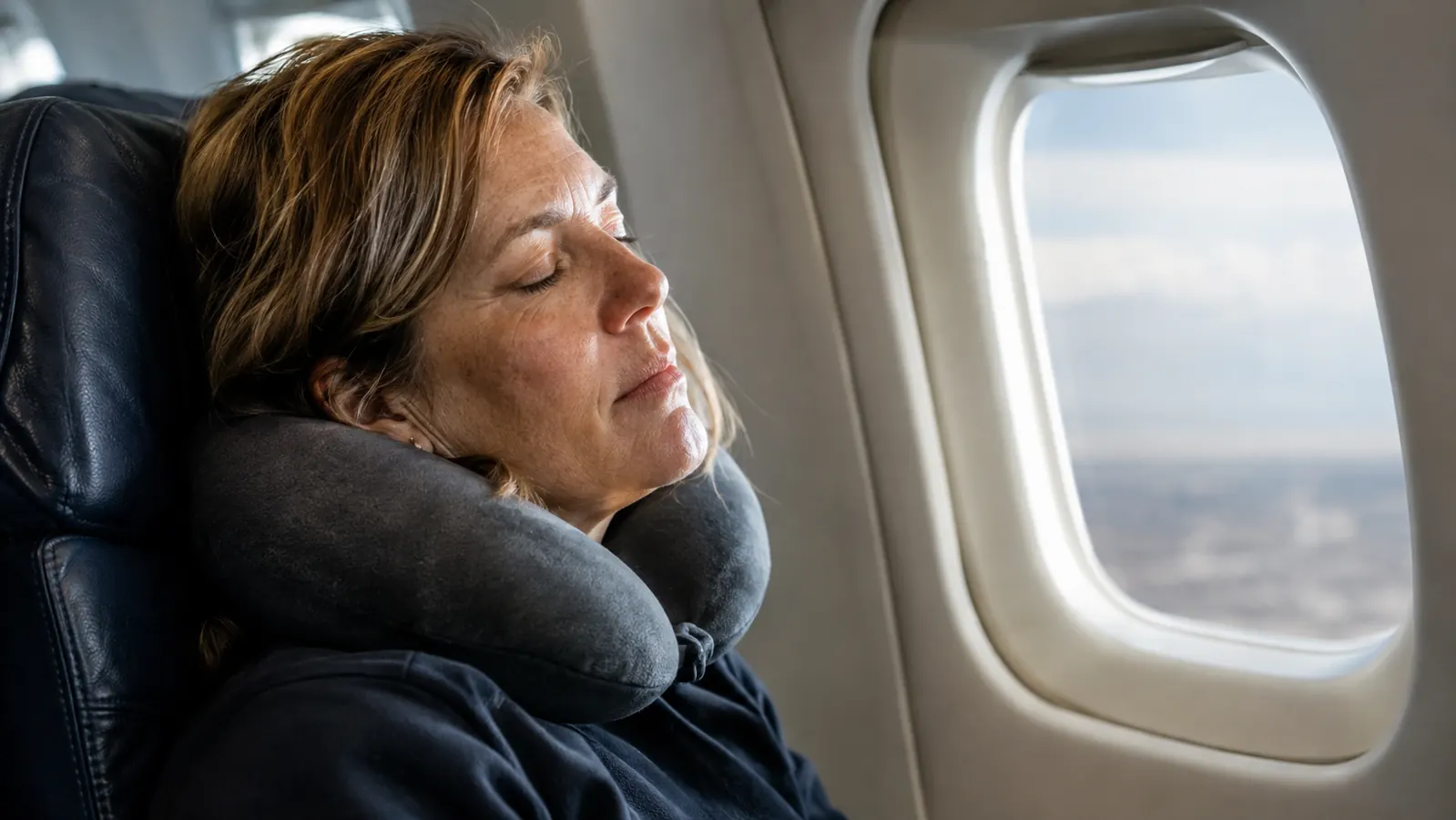
For years I treated the neck pillow as a joke. I would see them poking out of carry-ons and think, that is just something else to hold. Then I turned 50, my left knee started complaining on long walks, and suddenly a six-hour flight to Europe stopped being a minor inconvenience and became a real test. I am Corinne, a retired middle-school geography teacher from Denver, and I fly five or six times a year. I have fallen asleep on trains, in airport terminals, and once, memorably, on a bench in the Denver airport while waiting for a delayed connection. But sleeping on a plane, actually sleeping, took me years to figure out. The napfun Neck Pillow for Travel is the first one that made me understand what the whole category was supposed to do.
This guide is the setup I now use on every flight over three hours. It is not complicated. It is a specific order of operations, a few small adjustments, and one honest piece of advice about what a neck pillow can and cannot do. If you have tried one before and given up, I would ask you to try again with this method. The pillow was only half the fix. The other half was how I used it.
The pillow that finally made me stop waking up with a crick in my neck
The napfun memory foam neck pillow supports your head without propping your chin up at an unnatural angle. It is the one I reach for on every flight now.
Amazon Check Today's Price on Amazon →Step 1: Choose the right seat before you choose the pillow
The pillow matters, but the seat matters more. I have learned this the hard way. A middle seat on a full flight means you cannot lean away from anyone, and a window seat with a cold metal wall is not the cozy nook it looks like in photos. My rule now is simple: if I want to sleep, I book a window seat. It gives me one solid surface on my left side, a wall to lean against, and nobody asking me to get up so they can use the bathroom.
I also check the seat width before I book. On a narrow-body plane, a bulky memory foam pillow can feel like it is competing with your shoulders for space. The napfun pillow is not the bulkiest I have tried, but it is still a real pillow, not a thin inflatable. If you are in a middle seat, you may want to inflate a thinner option instead. If you are in a window seat, the memory foam version is worth the space it takes up in your bag.
One more thing: avoid the last row if you can. The seat does not recline as much, and the wall behind you can push your head forward. I learned this on a flight to Chicago when I woke up with my chin on my chest and a headache that lasted the rest of the day. On that same trip I checked the seat map before booking and picked 23A, only to discover the row behind the exit had a wall that did not move. Now I look for the little icon that shows a reclining seat, and I avoid anything marked as a limited-recline row.
Step 2: Put the pillow on backward, then adjust it
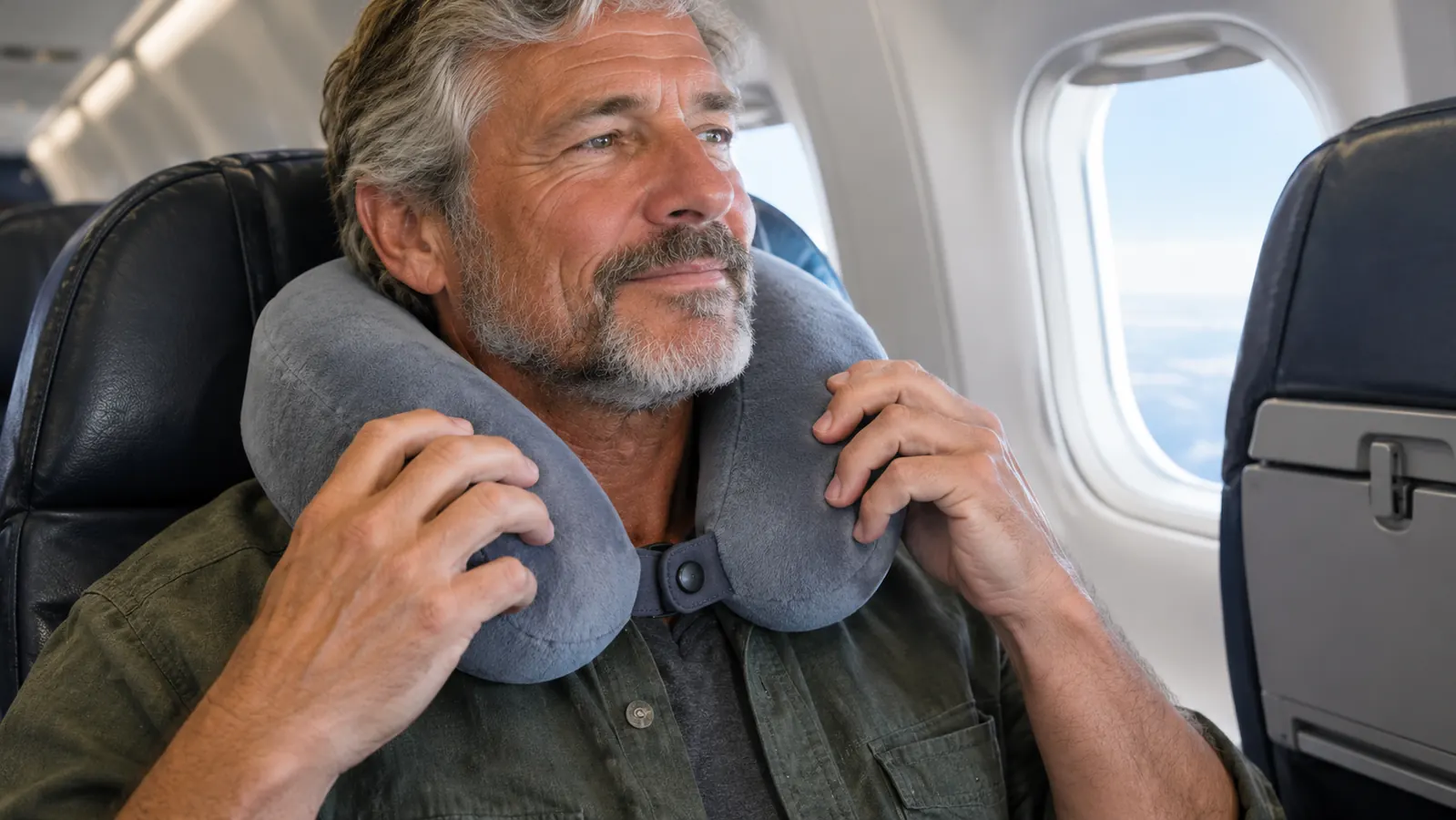
Here is the part that changed everything for me. Most people wear a neck pillow with the thicker part at the back of the neck, like a horseshoe facing forward. That is exactly backward for sleeping upright. When you put the thicker part at the back, your head gets pushed forward, and you wake up with your chin on your chest. Instead, put the pillow on so the thicker part sits under your chin, with the opening at the back of your neck. Your head can then rest back into the curve of the pillow, and your chin is supported so it does not drop.
The napfun pillow has a contoured shape that makes this easier. The taller section supports the side of your head, and the lower section tucks under your chin. I adjust it once, then again after I sit down, because the seat position changes everything. The clasp at the front is easy to reach, so I can fine-tune it without taking the pillow off. On a recent flight to Boston I must have adjusted it three times in the first hour, and each small turn of the clasp made the difference between a sore neck and a comfortable one.
It took me two flights to get comfortable with wearing it backward. It looks a little odd, and my husband Mark, a retired electrician who packs too little and sleeps anywhere, laughed at me the first time. Then he fell asleep against the window and woke up with a stiff neck, and he stopped laughing. Now he asks to borrow mine on long flights. I have thought about buying him his own, but I am not sure he would use it, and I would rather keep mine where I can reach it.
Step 3: Use the tray table as a chin rest, not a desk
This is the trick I have never seen in a travel blog. When the seatbelt sign is off and the person in front of me has their seat upright, I lower the tray table partway, just enough to rest my crossed arms on it, and then I rest my chin on my arms. The napfun pillow supports the sides of my head, and my arms support the front. It sounds awkward, but it is remarkably stable. I have slept this way for two hours on a flight to Iceland, and I woke up with my neck feeling better than it does after a night in my own bed.
The key is to keep the tray table low enough that you are not hunched over. If you are bent forward at the waist, you will wake up with a sore back. The goal is a straight spine with your head tilted slightly forward, supported by the pillow on the sides and your arms in the front. I aim for the tray table to sit about level with my ribcage, not my chest, and I keep my elbows tucked in so I do not crowd the person next to me.
If the person in front of me reclines, I adjust. I either sit up and lean back into the pillow, or I turn the pillow so the thicker part is at the back and use it as a headrest against the seat. The pillow is flexible enough to work both ways, which is why I keep it in my carry-on even on short flights. On a two-hour hop to Phoenix last spring, I did not even take it out of the bag until the descent, and then I used it as a lumbar cushion instead.
Step 4: Build a small sleep kit around the pillow
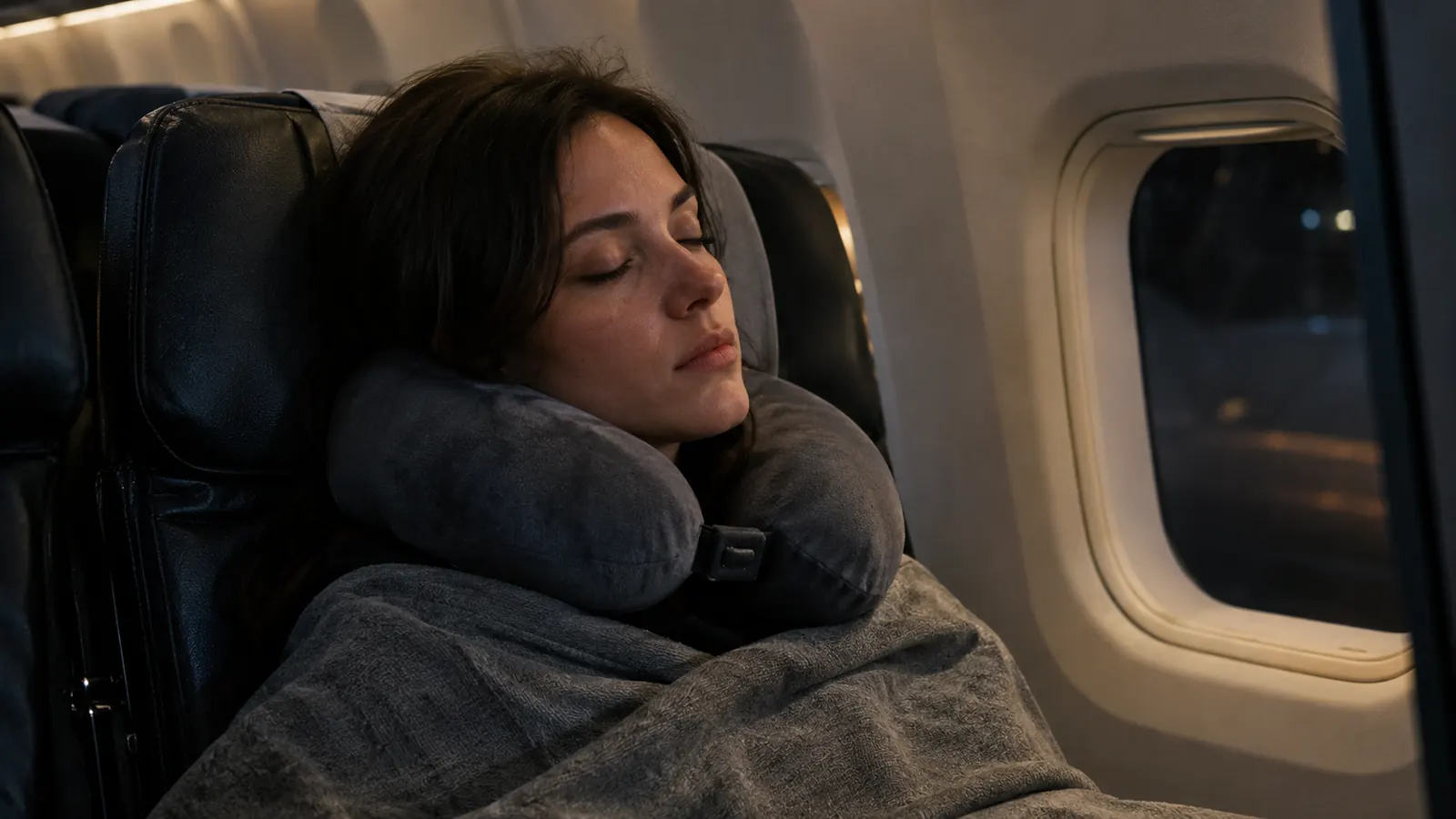
The pillow is the centerpiece, but it is not the whole system. I now carry a small sleep kit in the outer pocket of my carry-on: a lightweight eye mask, a pair of foam earplugs, and a thin scarf that doubles as a blanket. The eye mask matters more than I expected. The cabin lights stay on during boarding and sometimes during the flight, and a good mask blocks all of it. I learned this on a red-eye to London when the crew kept the aisle lights on for the whole flight, and I was the only one in my row who slept.
The earplugs are for the person who snorts when they wake up, the baby two rows back, and the cabin service cart. I do not need total silence, but I do need the sharp sounds softened. The scarf is for the cold air that always seems to find my shoulders. A cold neck makes it impossible for me to relax, and the scarf tucks around the pillow nicely. I fold it into a narrow strip and wrap it once around the back of the pillow, which keeps it from slipping off while I sleep.
I also take a small water bottle through security and fill it at a fountain near the gate. Being dehydrated makes my neck ache faster, and I would rather have to get up to use the bathroom than wake up with a headache. Mark thinks this is excessive. Mark also falls asleep in under five minutes on a moving bus, so I do not take his advice on sleep. On a long flight I will drink about half the bottle before the meal service and the rest after, so I am not getting up every hour.
Step 5: Time your sleep to the flight, not the other way around
The best pillow setup in the world will not help if your body is not ready to sleep. I have made this mistake more times than I can count. I would stay up late the night before a red-eye, thinking I would sleep on the plane, and then I would be too wired to sleep when I got there. Now I treat the flight like a nap, not a night of sleep. I aim to be mildly tired, not exhausted. The difference is that a mildly tired body will actually let go when the cabin gets quiet.
For a daytime flight, I set an alarm for an hour before we board and do a quick walk through the terminal. For a red-eye, I try to stay awake until the meal service is done, then put on the eye mask, adjust the pillow, and let the rhythm of the plane do the rest. The napfun pillow is comfortable enough that I can fall asleep within about twenty minutes of the cabin lights going down. On a recent overnight to Reykjavik, I was asleep before the drink cart reached my row.
I also set a second alarm on my phone for thirty minutes before landing. It is a gentle reminder to wake up, use the bathroom, and put my shoes back on before the plane starts its descent. Waking up groggy and disoriented while the person next to me is trying to get their bag down is not a good look, and it is avoidable with one small alarm. I set the alarm for the scheduled landing time minus forty minutes, which gives me time to wake up slowly and still be ready.
What Else Helps
A few other things have made a real difference for me. I wear layers, because the temperature on a plane can swing from freezing to stuffy in an hour. I keep my carry-on under the seat in front of me, with the sleep kit in the outer pocket, so I do not have to dig through the overhead bin in the dark. And I book flights that land at a reasonable hour whenever I can, because arriving exhausted is the fastest way to ruin the first day of a trip. On our last trip to Italy, we landed at noon instead of 7 a.m., and we were both able to enjoy the first afternoon instead of napping through it.
I also want to be honest about what a neck pillow cannot do. It cannot turn a middle seat into a bed. It cannot fix a flight that leaves at 6 a.m. after a night of no sleep. It cannot make a three-hour delay feel short. What the napfun pillow does is remove the biggest obstacle I had, which was my head constantly falling forward and waking me up. That one fix made every other part of flying easier. I still do not love flying, but I no longer dread the sleeping part of it.
The pillow was only half the fix. The other half was learning to put it on backward, use the tray table as a chin rest, and time my sleep to the flight.
Try the setup that finally worked for me
The napfun memory foam neck pillow is the one I keep in my carry-on for every flight over three hours. It supports your head, tucks under your chin, and packs down small enough to forget it is there.
Amazon Check Today's Price on Amazon →