

The first time I flew to Europe after retiring, I packed like I was still teaching a unit on world cultures. Three adapters, two voltage converters, a power strip, and a tangle of cables that took up half my carry-on. By the end of that trip, one adapter had stopped working, another only fit half the outlets we tried, and Mark had given up and borrowed a charger from the front desk. There is a better way, and it starts with one simple piece of gear: a universal travel adapter. The EPICKA Universal Travel Adapter has been in my bag for every trip since, and this guide is the method I wish someone had handed me before that first chaotic packing session.
Here is the honest part. A universal adapter does not convert voltage, and it does not magically make every device charge at home speed. What it does is remove the single biggest headache of traveling with electronics: the wall outlet. Once you understand the three things that actually matter, plug type, wattage, and how many devices you need at once, the whole process becomes boring and reliable. That is the goal. Boring and reliable.
Start with the adapter that has handled 19,000+ travelers' outlets
The EPICKA Universal Travel Adapter covers 150+ countries, fits most standard devices, and gives you five ports so you can charge everything at once. It is the one I reach for first on every trip.
Amazon Check Today's Price on Amazon →Step 1: Know What You Are Actually Plugging In
Before you buy anything, look at the little brick on each charger you own. It tells you everything. Phones, tablets, cameras, e-readers, and most modern laptops are dual voltage. That means they accept 100 to 240 volts, so they work anywhere in the world with just a plug shape change. You will see something like 'Input: 100-240V' printed right on the charger. If you see that, you do not need a converter. You only need an adapter.
The things that need a real voltage converter are big appliances with motors or heating elements: hair dryers, curling irons, electric kettles, and the like. I learned this the hard way when I plugged a US-only curling iron into a European outlet through a simple adapter and watched it glow like a small sun. The adapter did its job. The curling iron did not survive. So step one is really about sorting your bag into two piles: dual voltage devices that just need a plug shape, and high wattage appliances that need a converter or should stay home.
For most of us, the dual voltage pile is the whole trip. My phone, my Kindle, Mark's tablet, our camera, and a small battery pack all say 100-240V. That means one universal adapter can handle all of them, which is why the EPICKA adapter with its five ports has become the center of our charging setup.
A quick way to check is to look for a line like INPUT: 100-240V on the charger or power brick. If you see that range, the device works anywhere in the world with only a plug adapter. If you only see 120V, the device is not dual voltage, and you will need a converter or a replacement made for the local voltage. Do this check at home, at the kitchen table, before you pack anything.
Step 2: Pick a Universal Adapter That Covers the Countries You Visit
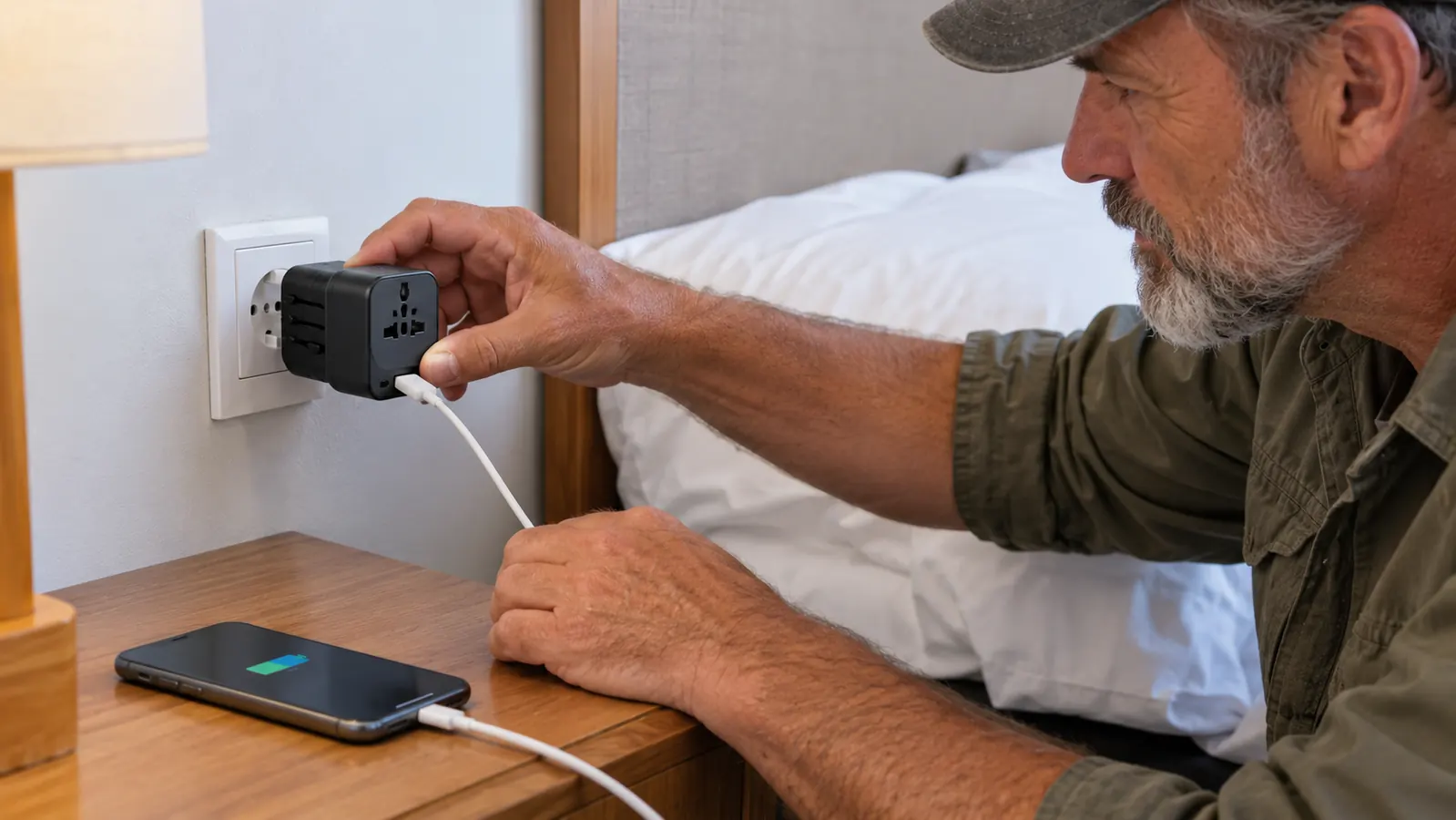
A universal travel adapter works by letting you swap the plug configuration or by sliding different prongs out of the body. The EPICKA covers the four main plug types used in over 150 countries: the flat US style, the round European style, the three-prong UK style, and the angled Australian style. That covers most of the places a person actually travels, from London to Tokyo to Buenos Aires.
When I am packing for a trip, I check the plug type for the country I am flying to, slide the right prongs out, and test it once against a wall outlet at home before I zip the bag. That thirty second test has caught two mistakes, including the time I was sure the UK prongs were out when they were not. Do not trust your memory. Trust the outlet.
One thing I appreciate about the EPICKA design is that the prongs slide out and lock into place. Some cheaper adapters have flimsy prongs that wobble, and a wobbly adapter is a fire risk and a frustration. The EPICKA feels solid in the hand, and the prongs click firmly. After eleven trips and dozens of hotel outlets, mine still locks up tight.
Step 3: Check Wattage Before You Plug In Anything Big
Here is the rule I now follow, and I wish I had followed it years ago. If a device is dual voltage, plug it into the adapter and go. If it is a high wattage appliance like a hair dryer or a travel iron, do not plug it into a universal adapter at all. The adapter is not the problem. The device is drawing more power than the adapter is designed to pass through safely.
The EPICKA adapter is rated for up to 10 amps, which is plenty for charging phones, tablets, cameras, and laptops. It is not designed for a 1500 watt hair dryer. For that, you would need a dedicated voltage converter, and honestly, most hotels outside North America have hair dryers in the bathroom. I stopped packing mine entirely. Mark still packs his electric razor, but that is dual voltage, so it charges through the adapter without any drama.
If you are ever unsure, the safe move is to read the label on the device or its charger. The label will list the wattage or the voltage range. If it says 100-240V, you are fine. If it lists only 120V, leave it home or bring a proper converter. That one habit has saved me from repeating the curling iron incident.
Wattage matters most for anything that heats. Hair dryers, curling irons, travel kettles and heated rollers draw far more power than a phone charger, and many of them are single voltage. Plugging one into a universal adapter abroad changes only the plug shape, not the voltage, and that is how hair dryers end up smoking in hotel bathrooms. I leave mine at home and use the one the hotel provides.
Step 4: Charge Everything at Once, the Right Way
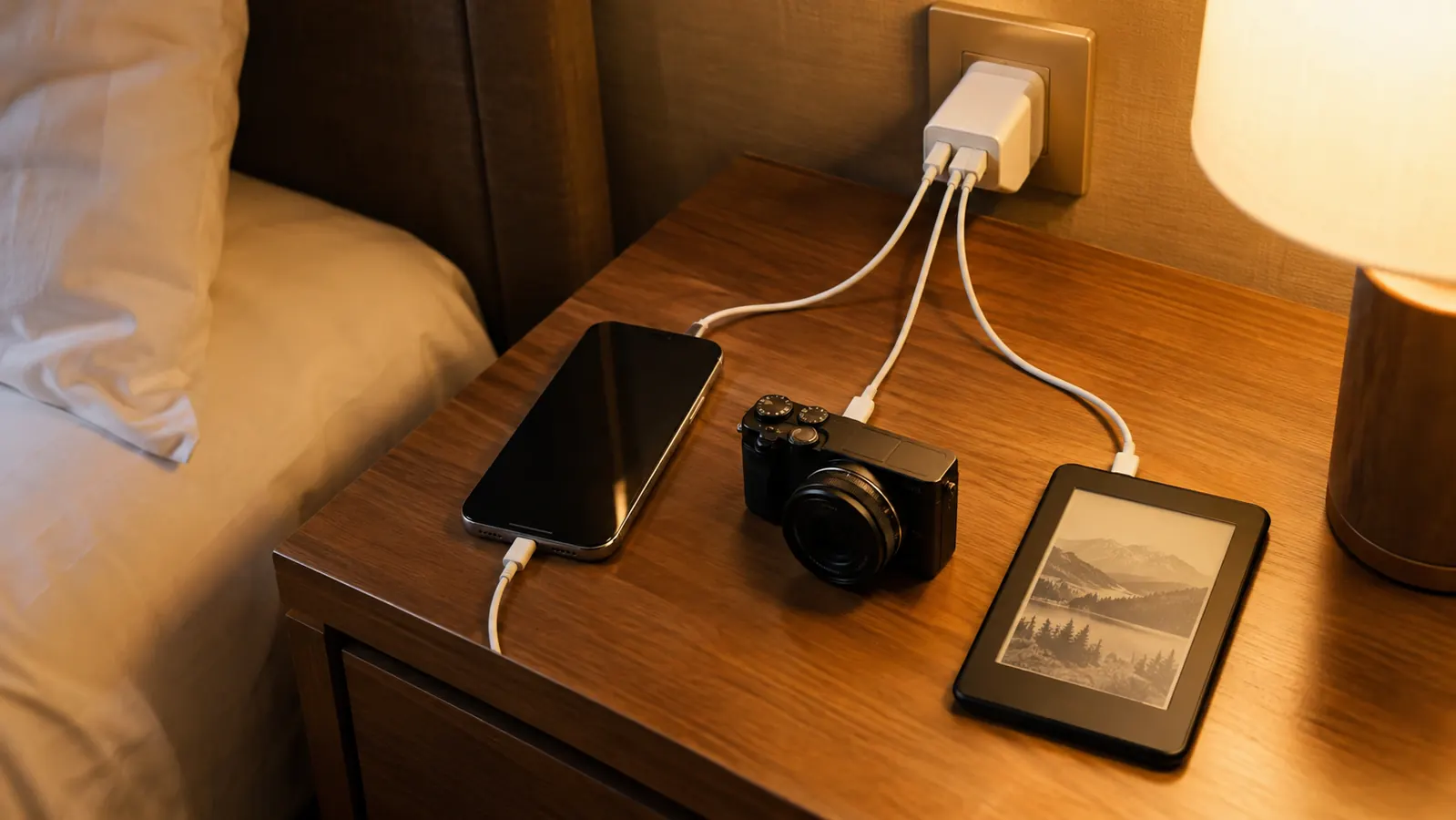
The biggest upgrade from my old single outlet adapter is having five ports on one device. The EPICKA has one AC outlet, three USB-C ports, and two USB-A ports. That means I can charge my phone, Mark's phone, my Kindle, the camera, and a battery pack all from one wall outlet. In a hotel room with one accessible outlet behind the nightstand, that is not a luxury. It is the difference between a calm evening and a scavenger hunt.
A quick note on USB-C. The EPICKA's USB-C ports support fast charging for phones and tablets, which matters more than you might think. On a long travel day, I want my phone to gain real battery while we are at dinner, not just a trickle. The USB-C ports on this adapter have handled everything from my iPhone to Mark's Android without complaint.
One habit that has saved me more than once: charge during meals. When we sit down for dinner, I plug in the adapter, connect the phone and the camera, and by the time the check arrives, everything is topped up. It sounds small, but it means we never start a day with a dead phone and a lost photo opportunity.
When you charge several devices at once, start with the ones you need first. I plug in my phone and Mark's phone on the USB-C ports overnight and charge the tablet and the camera batteries in the morning while we get ready. The EPICKA adapter handles it fine, but spreading the load also means everything is not depending on one wall socket at once. If the adapter feels very warm, unplug something and give it a rest.
Step 5: Pack It Where You Can Find It
The adapter is small, about the size of a deck of cards, which means it is easy to lose in a carry-on full of snacks, books, and the jacket Mark insists he will wear but never does. I keep mine in the front pocket of my personal bag, in a small zippered pouch with a spare charging cable. That way I can grab it at security, at the gate, or in the hotel room without unpacking everything.
I also pack a short extension cord, about three feet long. This is the trick that changed everything. Hotel outlets are never where you need them. They are behind the bed, behind the dresser, or in the bathroom. A short cord plugged into the EPICKA adapter means I can put the adapter on the nightstand and charge everything within reach. The adapter stays in the wall, the cord gives me reach, and the five ports give me room for everything.
And when the trip is over, the adapter goes back in the same pouch, in the same pocket, every single time. Routine is what keeps a small item like this from becoming a last minute purchase at an airport shop for twice the price.
What Else Helps
A few extras have made charging abroad genuinely painless. A 10,000 mAh battery pack covers the days when we are out from breakfast to dinner and the hotel room is too far away. A three foot extension cord, as I mentioned, solves the outlet placement problem. And a small cable organizer keeps the whole setup from becoming a nest of knots. None of these are expensive, and together they turn charging from a daily frustration into a two minute routine.
I will also say this: the EPICKA adapter has a built in fuse, which is a small thing that gives me real peace of mind. If something goes wrong with the power draw, the fuse is designed to protect your devices. I have never needed it, but I like knowing it is there. For a piece of gear that sits between a foreign wall and an expensive phone, that matters.
The adapter is not the exciting part of a trip. It is the part that keeps the exciting parts from being interrupted by a dead phone and a lost photo.
Do this once and it becomes second nature on every trip.
Make the adapter the first thing in your bag
The EPICKA Universal Travel Adapter has been in my carry-on for eleven trips and counting. It covers 150+ countries, charges five devices at once, and has never let me down. Check today's price on Amazon and see if it fits your packing list.
Amazon Check Today's Price on Amazon →