
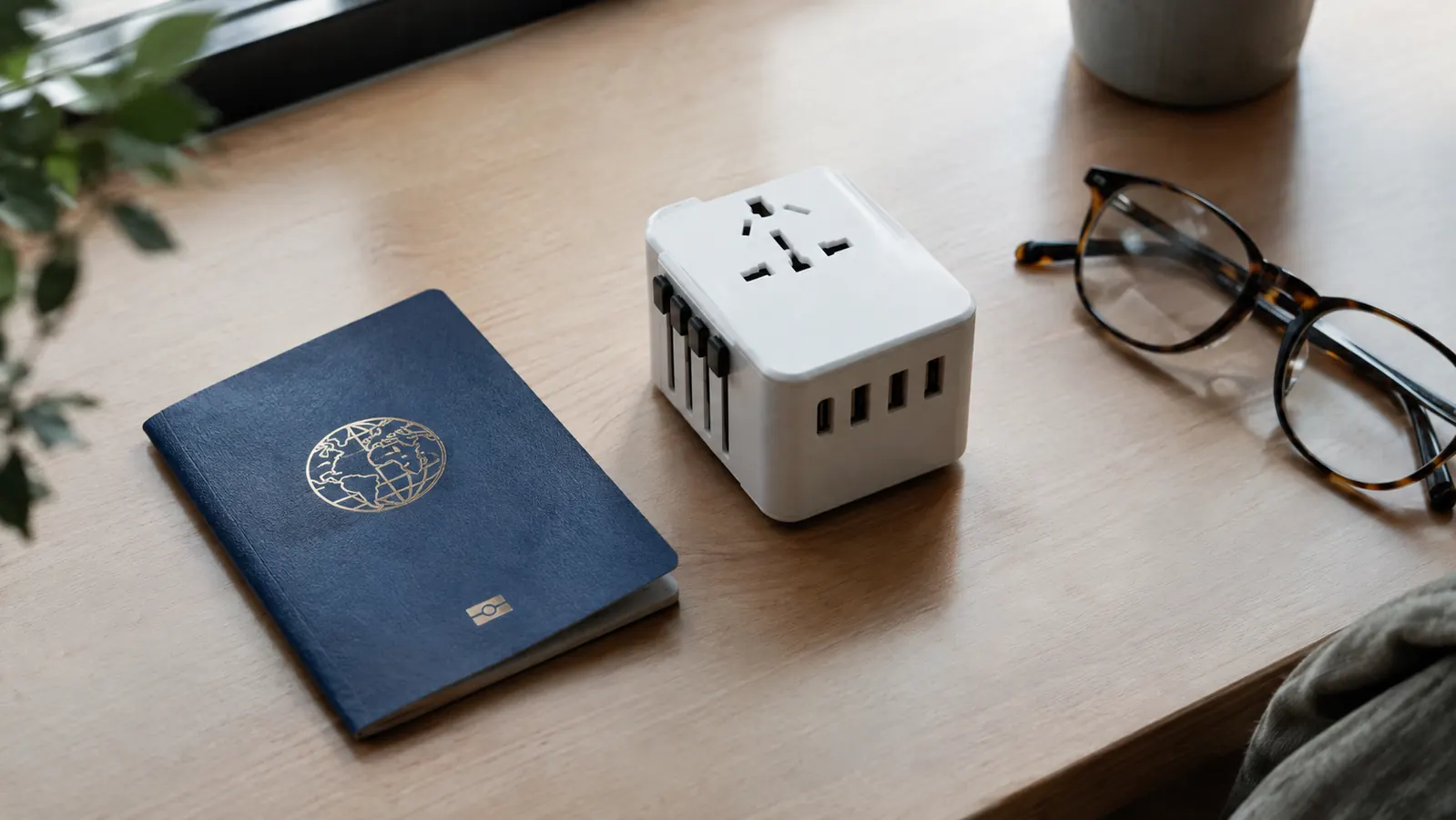
I will be honest with you. I bought the EPICKA universal travel adapter because it had the most ports of anything I could find, and I was tired of carrying three separate chargers for a phone, a tablet, and a camera. Twenty-eight years of teaching geography made me an expert at packing a bag, but it took one trip to Lisbon to show me how much I still had to learn about plugs. This review is the thing I wish someone had told me before I bought it.
The Quick Verdict
The EPICKA universal travel adapter is the one I reach for every trip now, but it is not the perfect adapter the listing photos suggest. The ports are generous, the fit is solid in most countries, and it handles heat better than I expected. The catch is that it is bigger than it looks, the USB-C ports are not all equal, and it will not fix a hotel room with only one outlet.
Amazon Check Today's Price →The adapter I now pack for every trip
After eleven trips and dozens of hotel rooms, the EPICKA universal travel adapter is the one that stays in my bag. Check today's price on Amazon and see if it fits how you travel.
Amazon Check Today's Price on Amazon →How I've Used It
I have used this adapter on eleven trips since I bought it, including Lisbon, Bangkok, London, Tokyo, Mexico City, and a long weekend in Madrid. That mix matters because it covers the four main plug types you actually run into, and it gave me a fair test of how the adapter fits in outlets that are recessed, loose, or mounted sideways. My husband Mark, a retired electrician, has opinions about electrical things, and he has inspected this adapter more closely than any human should. His verdict, in his words: it is built better than most of the cheap ones, and the pins feel solid when they seat.
My own test is less technical. I charge a phone, a tablet, and a camera battery every night, and I have learned to notice when a charger runs hot, when a plug wiggles, and when a port stops working. The EPICKA adapter has not done any of those things. It runs warm, not hot, even with three devices plugged in overnight, and the pins have held their grip in every outlet I have tried.
The one thing I did not expect is how often I use the USB-A ports. My camera battery charger still uses an old USB-A cable, and my earbuds case does too. I bought this adapter for the USB-C ports, but the two USB-A ports are the ones that save me on every single trip.
I have used the EPICKA adapter on trips to Portugal, Spain, England and Mexico, plus a couple of hotel rooms at home where the only outlet was hidden behind the bed. In each country I slid out the matching plug, pushed it into the wall and charged our phones, a tablet, my camera battery and Mark's electric razor from the one unit. That is the whole point, and it delivered every time.
The Ports: What Nobody Tells You
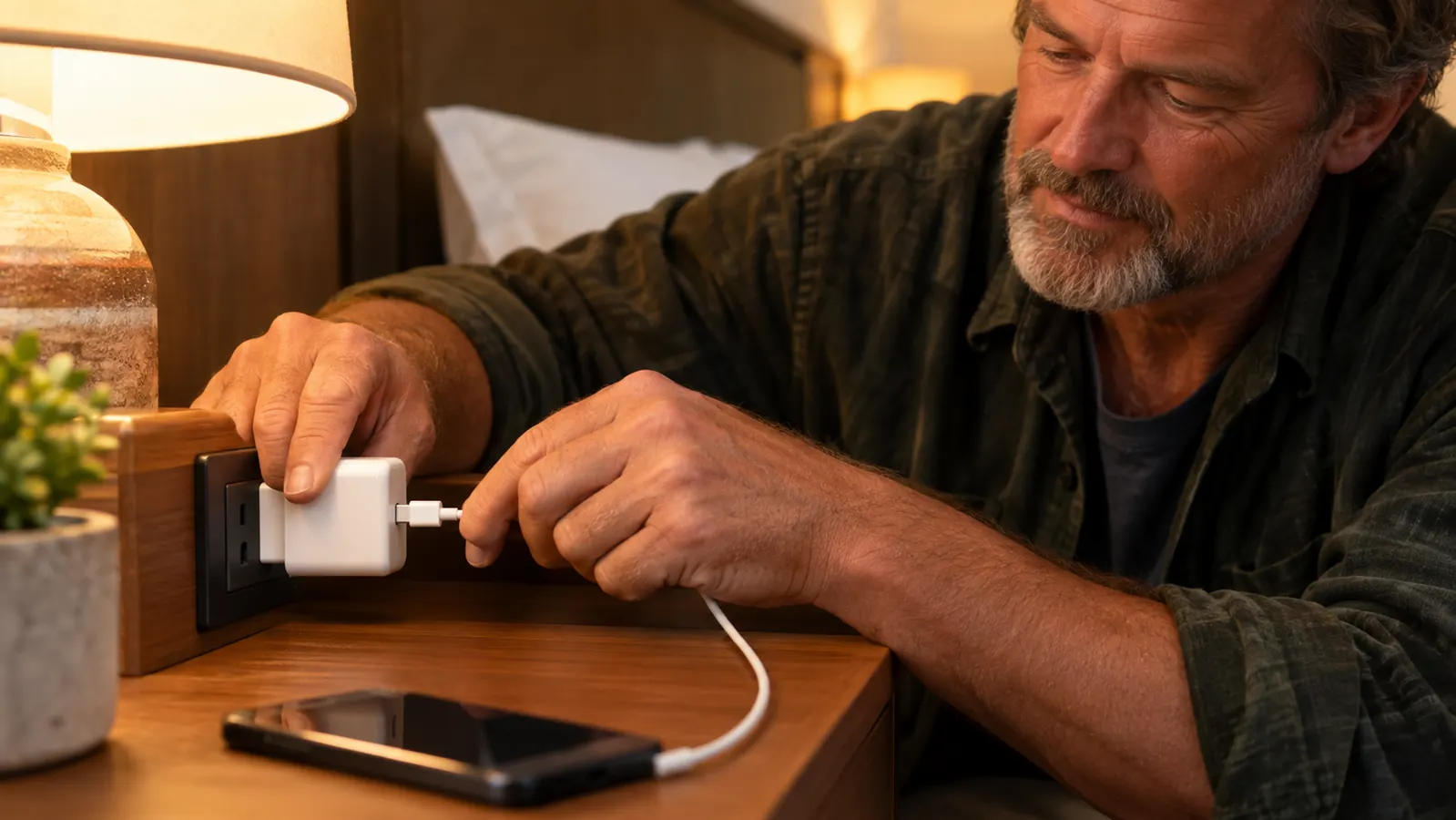
The listing says 1 AC, 3 USB-C, and 2 USB-A ports, and that is true. What the listing does not tell you is that the three USB-C ports are not identical. One of them is the main port that handles the fastest charging, and the other two are fine for a phone or earbuds but slower for a tablet. I learned this the hard way in Bangkok when I plugged my tablet into the wrong port and woke up to a battery that had barely moved.
The fix is simple once you know it: use the main USB-C port for the device you need charged fastest, and use the other two for things that can take their time. It is not a flaw so much as a quirk, but it is the kind of quirk that only shows up after you own the thing.
The AC port is where this adapter earns its place in my bag. It accepts a standard two-prong or three-prong plug, which means my laptop charger works without a separate adapter. That alone has saved me from carrying a second gadget on every trip.
Six ports sounds like overkill until you share a room with someone. Between my phone, Mark's phone, a tablet, a watch and a camera battery, we use five of them almost every night. The USB-C ports charge our phones noticeably faster than the old USB-A cube I used to carry, and having the AC outlet free for a laptop charger means nobody has to take turns.
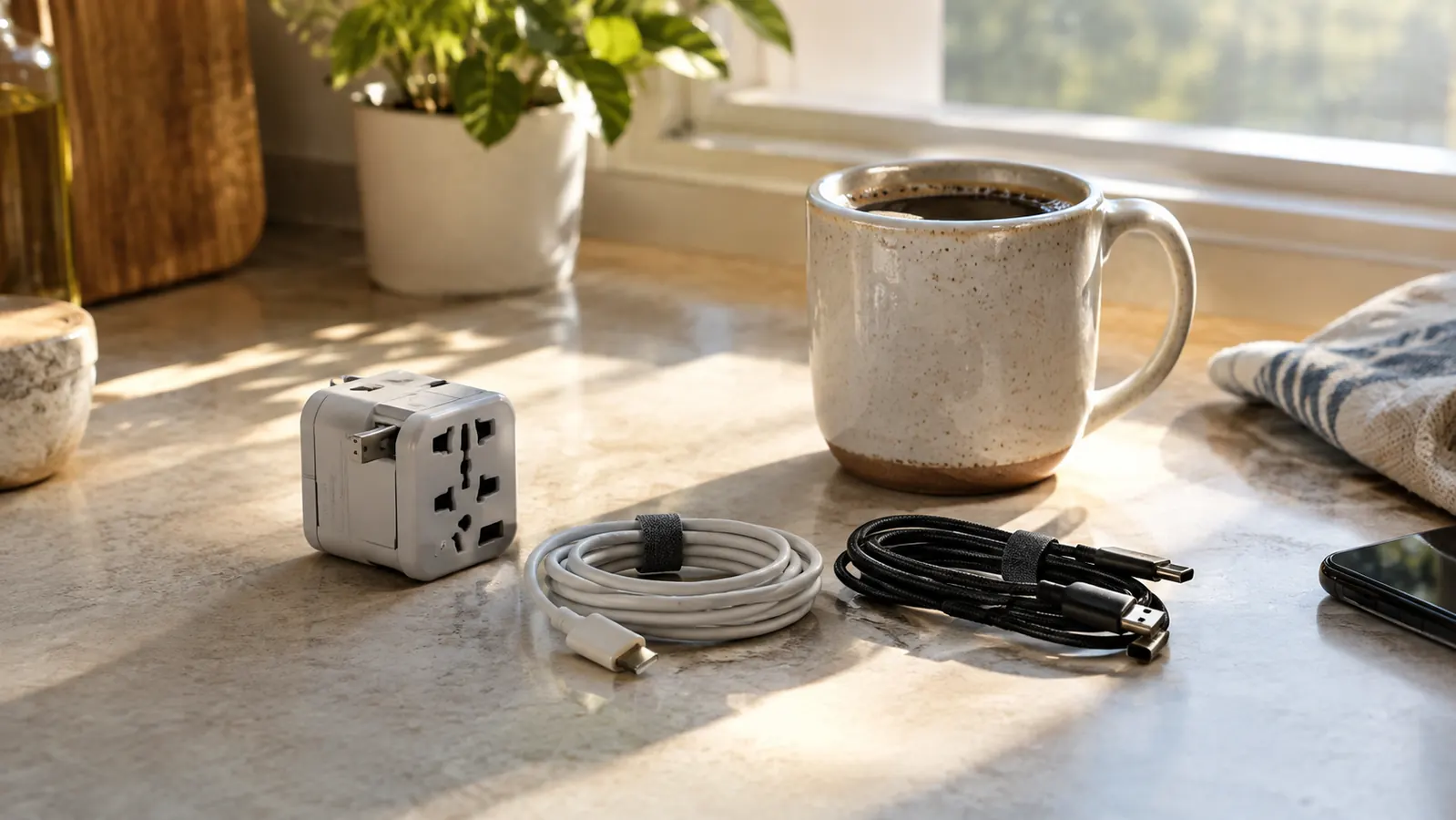
What nobody tells you is that more ports means more cords. I keep a short cable for each device bundled with a hair tie in a small pouch, so I am not untangling a nest of wires at midnight. The adapter is only as tidy as the cords you plug into it.
Fit and Grip: The Part I Was Most Worried About
I have a bad left knee, which means I do a lot of sitting while I wait for Mark to finish packing. From that chair I have watched him wrestle with adapters that fall out of the wall, adapters that block the adjacent outlet, and adapters that feel like they are going to snap in half. The EPICKA adapter has done none of that. The pins seat firmly, and the body is solid enough that I do not worry about it breaking in my bag.
The tradeoff is size. This adapter is bigger than it looks in the photos. It is about the size of a small bar of soap, and it sticks out from the wall more than a single-country plug does. In most hotel rooms that is fine. In a tight spot behind a nightstand, it can be awkward. I have learned to check the outlet before I commit to a room layout.
One more thing about fit: in older outlets, especially in Mexico City, the adapter sat a little loose at first. Mark says that is the outlet, not the adapter, and he is probably right. A gentle push seated it fully, and it stayed put for the rest of the trip.
Fit was my biggest worry, because old European outlets can be loose. In a small guesthouse in Lisbon the adapter sagged a little in the wall socket with a laptop charger plugged into it. I fixed it by plugging the heavy charger into a different socket and using the EPICKA only for USB devices there. In newer hotels it sat firmly and never moved.
The listing says three USB-C ports. What it does not say is that only one of them charges a tablet at full speed. That is the kind of detail you only learn after a slow night in Bangkok.
Heat: The Test I Did Not Plan
I did not set out to test how hot this adapter gets. It just happened. In Tokyo, I left a phone, a tablet, and a camera battery charging overnight, and when I reached for the adapter in the morning, it was warm to the touch. Not hot, not alarming, just warm, the way a charger gets when it has been working all night. Mark, who has strong feelings about electrical safety, gave it a nod and said it was within normal range.
I have also used it in a hotel room where the only outlet was behind the bed, with the adapter pressed against the headboard. That is the kind of situation where heat can build up, and the adapter stayed warm but never hot. I would still avoid tucking it under a pillow or burying it under clothes, but I no longer worry about it the way I did at first.
The heat test happened by accident. One night in Spain I had all six ports in use for several hours. In the morning the adapter was warm to the touch but not hot, and everything was fully charged. I would not run a hair dryer or kettle through it, and the instructions say not to, but for electronics it handled a full load without complaint.
What Nobody Tells You About Travel Adapters
Here is the honest part. A universal travel adapter is not a power strip. It has one AC outlet, which means it will not fix the hotel room where you and Mark both need to charge laptops at the same time. I have started packing a small USB hub for those nights, and it has saved us more than once.
The other thing nobody tells you is that the adapter does not convert voltage. It only changes the shape of the plug. My phone, tablet, and camera chargers all handle the voltage themselves, so that is fine for me. But if you are bringing a hair dryer or a curling iron, this adapter will not make it safe to use in a country with different voltage. That is a real limitation, and I would rather say it plainly than have you learn it in a hotel bathroom.
And one more small thing: the adapter has a built-in fuse, which is good, but it means the adapter is not something you can fix in a hotel room if it ever fails. I have not needed the fuse in eleven trips, but I carry a cheap single-country plug as a backup anyway. Old habits from years of teaching: always have a plan B.
The other thing nobody mentions about travel adapters in general is that they are easy to leave behind. I have left two adapters in hotel walls over the years. Now the EPICKA goes back into the same pocket of my bag every single morning, and I check the wall before we leave the room. It sounds obvious, but it is the most common way people lose one.
Who This Is For
This adapter is for the traveler who carries a phone, a tablet, and maybe a camera, and who is tired of juggling three chargers. It is for the person who visits more than one country a year and does not want to think about plugs. It is for the person who, like me, would rather spend five minutes checking the outlet than five hours hunting for a charger in a foreign city.
It is also for the person who appreciates a solid build. Mark has handled a lot of electrical gear in his life, and he has called this adapter well made more than once. That matters to me, because I want the thing in my bag to work when I am six thousand miles from home.
The Honest Pros and Cons
What I Liked
- One unit covers the plug types for most of the countries we visit
- Six ports charge a whole room's worth of devices at once
- USB-C ports charge phones faster than older USB-A cubes
- Slide-out plugs mean no loose pieces to lose
- Stayed only warm, not hot, with every port in use overnight
Where It Falls Short
- Can sag in loose, older wall sockets with a heavy charger attached
- Changes the plug shape only, so it will not run single-voltage hair tools
- Bulkier than a single-country plug
- Easy to forget in a hotel wall, like any adapter
- More ports means more cords to manage
For a couple who travels with a handful of devices, the EPICKA adapter has been one of the most useful small things in my bag. I would buy it again and I have told friends to do the same.
Who Should Skip It
Skip this adapter if you only travel to one country and you never need more than one device charged at a time. A single-country plug is smaller, lighter, and cheaper, and it will do the job with less bulk. Skip it if you are bringing appliances that need voltage conversion, because this adapter will not help you. And skip it if you need to charge two laptops at once, because the single AC port will leave one of you waiting your turn.
I would also say this: if you are the kind of traveler who loses things, the size of this adapter might be a problem. It is not small, and it is easy to leave behind in a hotel room. I have started keeping it in the front pocket of my carry-on, right next to my passport, so I cannot forget it.
To be fair to the competition, a single-country plug is smaller and simpler if you only ever visit one place. But we rarely do. On a two-week trip through Spain and Portugal and home through London, the EPICKA adapter handled every hotel and every guesthouse without me thinking about plug shapes once, and that convenience is what I am really paying for.
If you buy one, test it at home before you go. Slide each plug out, make sure it locks into place, plug in a phone and confirm the ports charge. Five minutes at the kitchen table beats discovering a problem in a hotel room at eleven at night, and it also teaches you how the slider works before you need it in a hurry.
A final word on safety, because it matters with anything that goes into a foreign wall socket. The EPICKA adapter has worked reliably for us, but I still unplug it when we leave the room for the day, and I never leave a phone charging on the bed or under a pillow. It is a good habit with any adapter, in any country, and it costs nothing. Pair it with a short cord for each device and a fixed pocket in your bag, and charging abroad stops being something you ever have to think about at all.
Still deciding? Here is my honest bottom line
The EPICKA universal travel adapter is not perfect, but it is the best balance of ports, fit, and heat I have found in eleven trips. If that sounds like what you need, check today's price on Amazon.
Amazon Check Today's Price on Amazon →